
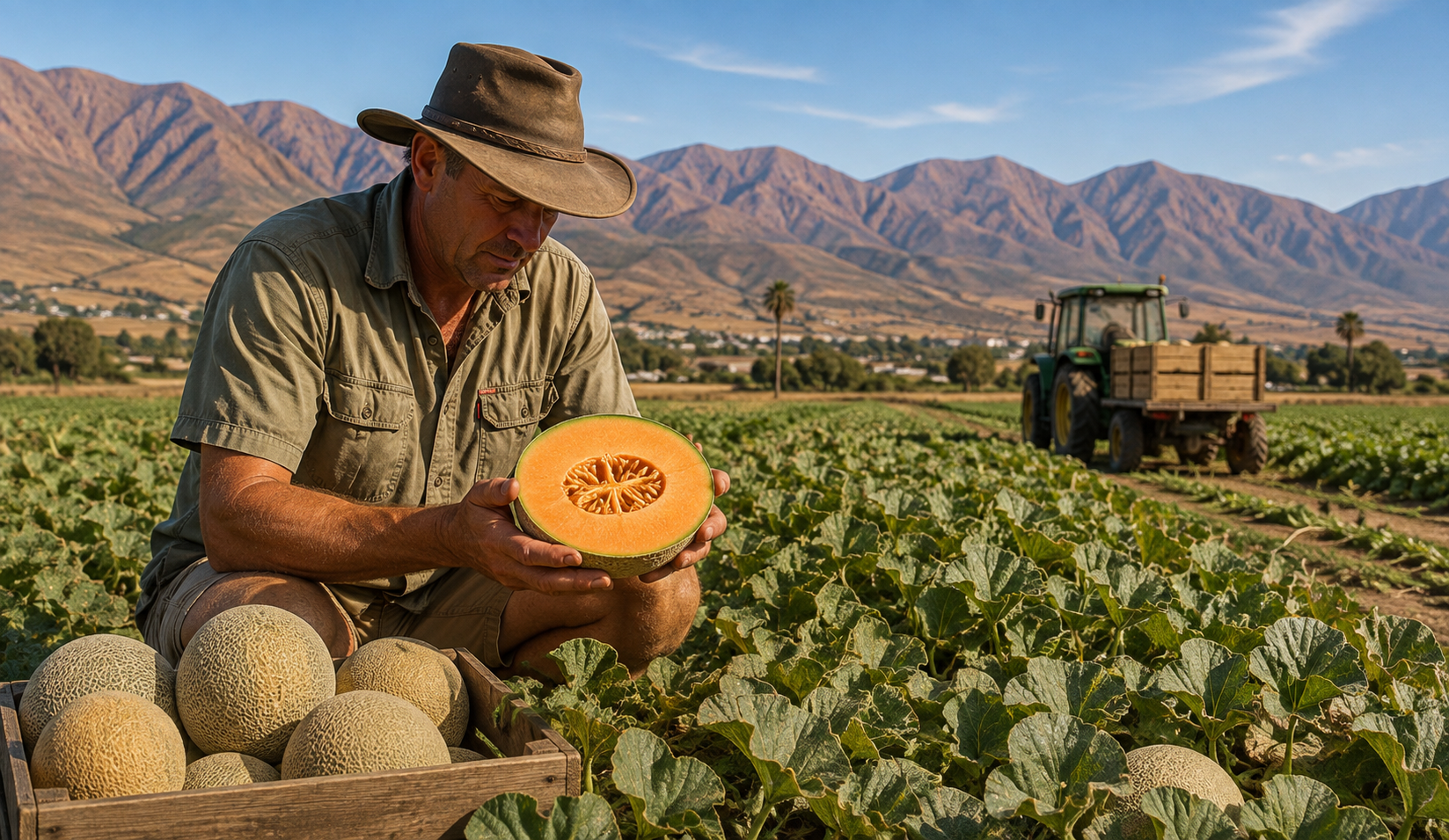
Growing for Gold: Timing the Crop for December and January
There is a moment every South African summer when spanspek seems to belong everywhere.
It appears chilled on breakfast tables at guest houses along the Garden Route, sliced beside Christmas trifle at family gatherings, packed into holidaymakers’ trolleys in coastal supermarkets and served cold after a long afternoon around the braai. Roadside farm stalls pile the fruit high, retailers expand their summer displays and restaurants turn towards lighter seasonal ingredients.

For the consumer, it is simply the taste of summer.
For the farmer, that moment began months earlier.
The spanspek cut open during Christmas week may have started its commercial journey in August or September, when the grower was looking across an empty field and making decisions about seed, soil, irrigation, labour and market timing. That is the essential difference between merely producing a crop and producing a profitable one: successful growers begin with the market and work backwards.
South Africa’s December and January holiday season creates an unusually concentrated opportunity for fresh produce. Millions of people travel, entertain, braai, eat outdoors and spend more time shopping for food. Coastal towns experience dramatic seasonal population increases, while families across the country prepare for Christmas, New Year and the school holidays.
Sweet melon fits naturally into this pattern. It is refreshing, convenient, visually attractive and strongly associated with hot weather. Yet a grower who only begins thinking about festive demand when the first fruit reaches maturity has already missed the most important part of the opportunity.
The real question is not simply, “When should I plant spanspek?”
It is: “When do I want my fruit to be bought?”
That question changes the production strategy completely.
For growers targeting the December and January market, profitable spanspek farming therefore begins with timing the crop to consumer demand.
South Africa’s Summer Advantage
South Africa is exceptionally well positioned for commercial spanspek production. Long sunny days, warm temperatures and established irrigation systems create favourable conditions across several production regions, while climatic diversity allows growers to supply the market over an extended summer period.
Early fruit can begin moving from warmer northern districts before the main crop develops further south. For growers, this geographical spread creates more than continuity of supply. It provides opportunities to target specific market windows, including the valuable December and January trade.
Understanding where each region fits into this seasonal progression is an important part of profitable spanspek farming, particularly when production is being planned around a specific festive-season window.

In Limpopo, warm spring conditions give growers around Groblersdal, Marble Hall, Bela-Bela, Musina and the Letaba region an opportunity to establish crops earlier than many cooler inland areas. Farmers pursuing late-November and early-December markets need cultivars capable of establishing strongly as temperatures rise, setting fruit reliably and reaching maturity early enough to exploit that opening market.
Mpumalanga’s Lowveld offers many of the same advantages. Strong sunlight, established irrigation and access to Gauteng’s huge consumer market create excellent potential, although heat, humidity and disease pressure mean vine vigour and disease resistance become increasingly important as the season develops.
North West is naturally suited to the main summer crop. Sunshine supports excellent sugar development, but high temperatures make healthy leaf cover and fruit protection important. A profitable cultivar in these conditions needs to do more than produce tonnes; it must deliver fruit of a size, firmness, sweetness and appearance that buyers can sell.
The Free State generally enters the cycle later because of cooler spring conditions. Once summer is established, however, irrigated production can produce excellent fruit. Uniform maturity becomes particularly useful when the farmer is attempting to concentrate harvest around a predetermined December or January sales window.
Gauteng produces less commercial spanspek than some neighbouring provinces, but proximity to Johannesburg, Pretoria and major fresh produce channels provides an obvious logistical advantage. Shorter distances between farm and consumer can allow growers to place greater emphasis on outstanding eating quality.
KwaZulu-Natal offers opportunities for an extended warm-season crop, although higher humidity places additional pressure on foliage and increases the importance of disease management. In the Eastern and Western Cape, irrigated production can target regional consumers as well as the enormous tourism economy that develops during the festive season. Dry heat and wind create their own challenges, but a carefully timed crop can be particularly profitable when holiday demand is at its strongest.
Geography creates the opportunity. Cultivar choice helps determine how effectively the farmer can exploit it.
Choosing the Right Cultivar
A seed catalogue can tell a farmer about yield potential, vigour and fruit characteristics. It cannot tell him precisely how that cultivar will perform on his farm.
Days to maturity matter because the crop is being aimed at a specific market window. Fruit size matters because retailers and households increasingly favour convenient, uniform fruit. Netting, flesh colour and sugar levels influence appearance and repeat purchases. Disease resistance influences production risk, while firmness and shelf life determine how successfully fruit survives the journey from field to consumer.
This is why cultivar selection sits at the heart of profitable spanspek farming: the farmer is choosing not only what will grow well, but what can ultimately be sold well.
South African growers have several strong commercial choices.
Colorspring is an early cantaloupe with a stated maturity of about 70–75 days under suitable conditions. It produces large, round-oval, well-netted fruit with firm bright-orange flesh, high Brix and long shelf life. Colorsweet falls into a similar maturity window, around 73–77 days, producing fruit of approximately 1.7–2.3 kg with firm orange flesh, high Brix and good storage characteristics. Both are recommended for summer production.
Sweet Spring offers another useful option. This Harper-type cantaloupe matures at approximately 80 days and combines good leaf cover with uniform fruit set. Fruit generally weighs around 1.9–2.5 kg, with deep-orange flesh, high Brix and long shelf life. Its resistance package includes Fusarium and powdery mildew, among other specified diseases.
For farmers who prefer the traditional aromatic characteristics of an Eastern Shipper, Venus remains an interesting option. It is suited to early-to-main-season production and is noted for wide adaptability, vigorous vines and dense canopy cover. It has also developed a following among consumers who prefer aromatic musk-melon characteristics, particularly in the Western Cape, Northern Cape and Free State.
Majestic F1 provides another commercial alternative for warm-season production. Its fruit averages approximately 1.7–2.0 kg, with firm salmon-orange flesh and reported Brix levels of 14–16%. The plants are vigorous and heat tolerant, while the fruit is uniform and intended for long shelf-life production.
Divine F1 produces somewhat larger fruit, averaging approximately 1.8–2.5 kg. It is adapted from cool-to-warm through warm-season production, has good heat tolerance and carries resistance to specified Fusarium wilt and powdery mildew races. Reported Brix levels range from 12–15%.
These characteristics provide growers with useful starting points. Colorspring and Colorsweet can be particularly interesting where early maturity matters; Majestic offers heat tolerance and high Brix for warm production; Sweet Spring combines eating quality with a useful disease package; Venus has wide adaptability and aromatic eating characteristics; and Divine provides strong internal quality and adaptability across a broader temperature range.
But cultivar selection should never end with a catalogue.
Small commercial cultivar trials remain one of the most valuable tools in profitable spanspek farming, particularly when introducing new genetics or targeting a different harvest window, marketable yield rather than total tonnes alone. Measure average fruit weight and Brix. Observe disease pressure, harvest concentration, firmness and shelf life. Then compare what actually earns money.
The cultivar producing the greatest tonnage is not necessarily the most profitable. A slightly lower-yielding crop that consistently achieves a better grade and stronger price may deliver considerably more per hectare.
The Festive Crop Starts Underground
Once cultivar and market window have been selected, attention moves below the soil surface.
Spanspek needs a well-drained root environment. Compaction, waterlogging and poor soil structure restrict root development and create conditions in which disease can gain an advantage. Soil analysis before planting should therefore establish the foundation for soil correction and the fertiliser programme.
Good soil preparation may never be visible to the consumer, but it remains one of the foundations of profitable spanspek farming.
Raised beds can improve drainage and encourage spring soils to warm more rapidly. Plastic mulch is valuable in intensive production because it reduces evaporation, suppresses weeds and keeps developing fruit cleaner. Combined with drip irrigation, it also gives the farmer much tighter control over conditions around the root zone.
That control becomes particularly important when the crop is being timed for a narrow commercial window. December will not wait because establishment was uneven in September.
Increasingly, farmers also have another tool available below ground: grafting.
Grafting: Building a Stronger Plant Below Ground

Grafting is already well established in intensive cucurbit production and deserves consideration where soil-borne disease or stressful growing conditions repeatedly compromise production.
The principle is straightforward. The selected spanspek cultivar forms the fruiting portion of the plant—the scion—while it is grafted onto a separate cucurbit rootstock chosen for characteristics such as vigour and disease resistance.
One commercial example available locally is RS841, an interspecific Cucurbita maxima × Cucurbita moschata rootstock suitable for sweet melon, watermelon and cucumber. It is described as highly resistant to Fusarium and capable of supporting stronger plants under stressful conditions including cold, heat and wind.
For farms repeatedly producing cucurbits, this can become particularly important. Soil-borne disease does not care that Christmas is approaching or that a buyer is expecting several pallets next week. Once root health deteriorates, the entire programme can unravel.
Grafting may therefore contribute to a more profitable production system where Fusarium pressure or difficult growing conditions justify the additional seedling cost.
Where recurring root problems threaten marketable yield, grafting can therefore become an important component of profitable spanspek farming rather than simply an additional production expense.
It is not a miracle solution. Rootstock vigour can affect vine growth and crop balance, and grafted seedlings require specialised nursery management. Farmers considering the technique should trial the rootstock and scion combination on their own farm before committing a large area.
Where the economics make sense, however, protecting the root system can help protect the entire festive-season investment.
Water Decides More Than Fruit Size
South African farmers hardly need reminding that water is valuable. In spanspek production, however, irrigation determines considerably more than whether a vine survives.
It influences establishment, flowering, fruit set, fruit expansion, cracking, disease pressure and ultimately eating quality.
Drip irrigation is particularly well suited to commercial spanspek because water can be delivered directly into the active root zone without unnecessarily wetting the foliage. It also opens the door to fertigation, allowing the grower to adjust nutrient supply as the crop develops.
Used correctly, that degree of control makes drip irrigation one of the most useful tools available for profitable spanspek farming under South African conditions.

What drip irrigation does not provide is a universal watering timetable.
A sandy soil in Limpopo during a scorching November week behaves very differently from a deeper loam in the Free State. Temperature, wind, evapotranspiration, mulch, root development and emitter output all influence how frequently water needs to be applied.
During establishment, the objective is consistent moisture around young roots. As vines develop, demand increases. Flowering and fruit set are particularly sensitive periods, and severe moisture stress can reduce fruit numbers before the farmer has anything worthwhile to harvest.
Demand remains high during fruit enlargement. Inconsistent irrigation at this stage can restrict size and place plants under unnecessary stress.
As fruit approaches maturity, irrigation requires greater finesse. Sudden heavy watering following a dry period can increase the risk of cracking, while excessive irrigation approaching harvest can work against the concentration of sugars associated with outstanding eating quality.
The profitable approach is neither flooding the crop nor deliberately stressing it. It is maintaining consistency and becoming increasingly precise as maturity approaches.
Soil-moisture monitoring can remove much of the guesswork. Even relatively simple monitoring equipment can tell the farmer far more than looking at the soil surface and hoping conditions underneath are similar.
Feed the Fruit, Not Just the Vine
The same precision applies to nutrition.
Nitrogen is important during establishment and early vegetative growth, but a field covered by enormous dark-green vines is not necessarily a successful field. Excessive nitrogen later in the production cycle can encourage vegetative growth at the expense of fruit development and maturity.
Phosphorus supports early root development. Potassium becomes increasingly important as fruit develops, while calcium contributes to fruit quality and post-harvest performance. The importance of potassium and calcium during fruit development is specifically highlighted in local technical guidance for Majestic and Divine.
Micronutrients also play important roles, but they should be managed according to analysis rather than habit.
Where drip irrigation is installed, fertigation allows growers to supply nutrients in smaller applications as plant demand changes. This can be considerably more profitable than applying large quantities simply because that is what was done the previous season.
A fertiliser programme should ultimately respond to the farm’s soil, irrigation-water quality, cultivar, yield expectations and, where available, tissue analysis. Copying another farmer’s programme may copy his costs without copying his results.
The Quiet Work of the Bees

For several weeks, a farmer can do almost everything correctly and still lose potential yield because of something remarkably small.
A bee.
Melons depend heavily on insect pollination. Poor pollination can result in fruit abortion, low fruit numbers and misshapen fruit that never reaches premium grade. For that reason, pollination should never be treated as an afterthought in profitable spanspek farming.
Pollination is therefore a production input, even though it does not arrive in a fertiliser bag.
Where natural pollinator populations are inadequate, managed honeybee hives can support fruit set. Crop-protection programmes should take bee activity into account, with all products used strictly according to their labels and applications managed to minimise pollinator exposure.
The financial logic is simple. A well-pollinated flower has the potential to become a marketable fruit. Poorly pollinated fruit may consume water, nutrients and time without ever returning the investment.
That makes good pollination part of a profitable hectare.
Planning Backwards From Christmas
This is where agronomy meets the calendar.
It is also where profitable spanspek farming becomes an exercise in commercial timing rather than production alone.
Current commercial cultivar information illustrates just how much maturity can vary. Colorspring is listed at approximately 70–75 days, Colorsweet around 73–77 days, Sweet Spring at roughly 80 days and Venus around 80–85 days under appropriate conditions.
These figures are useful planning tools, not promises from nature.
Temperature, planting method, region, soil and seasonal weather can all move the harvest date. Nevertheless, they demonstrate why August, September and October become decisive months for farmers targeting festive-season demand.
In suitable production areas, a late-August planting can position fruit for late-November and early-summer retail programmes. Early-September plantings can move into the first weeks of December. Later September plantings may line up with Christmas trading, while October crops can carry production towards the January holiday market.
For a farmer targeting this period, planting the entire crop on one day introduces unnecessary risk.
Staggering plantings at intervals—often two or three weeks apart where the production system permits—can spread exposure to weather, disease and harvest pressure. More importantly, it can turn one large harvest into several weeks of continuous supply.
A retailer has far more use for a farmer capable of delivering consistent quality throughout the festive period than one who arrives with an enormous crop and disappears from the market shortly afterwards.
Consistency is profitable.
Harvest for Flavour, Not Simply Appearance
The final production decision is one the consumer will taste immediately.
Harvest too early and the fruit may travel beautifully but disappoint when cut. Harvest too late and flavour may be outstanding while shelf life collapses.
Finding the point where eating quality, shelf life and market requirements intersect is one of the final disciplines of profitable spanspek farming.

Growers should therefore assess maturity using several indicators rather than relying on fruit size alone. Depending on the cultivar, these include background skin-colour changes, net development, aroma, cracking around the peduncle and the degree of stem separation or “slip”.
Colorspring and Colorsweet, for example, show maturity through net development, a change in rind colour and cracking around the peduncle, while Sweet Spring develops a straw-coloured background and radial cracking around the peduncle as it matures.
A portable refractometer adds another valuable piece of information by allowing growers to monitor soluble solids, commonly expressed as degrees Brix.
For formal supply programmes, Brix testing can help maintain consistency between harvests. A buyer receiving beautifully sweet fruit one week and bland fruit the next does not experience that as natural variation. The buyer experiences an unreliable supplier.
Fruit should be harvested during cooler periods where practical and handled gently from the moment it leaves the vine. Harvested melons should not be left baking in direct sunlight, and unnecessary impacts during loading, grading and packing must be avoided.
Good post-harvest handling does not add a single kilogram to yield, yet it can make the yield already produced considerably more profitable.
When the Market Moves to the Coast

Then December arrives.
Gauteng becomes quieter. National roads fill with holiday traffic. Families head towards Durban, Ballito, Umhlanga, Cape Town, Gqeberha, the Garden Route and countless smaller holiday towns. Guest houses serve breakfast to full dining rooms. Restaurants become busier. Families gather around braais and Christmas tables.
The spanspek crop planted months earlier suddenly finds itself in precisely the environment for which it was intended.
This is the commercial beauty of planning backwards.
The farmer is no longer trying to persuade the market to absorb whatever happened to be harvested. The crop was planned around a period when consumers were already likely to want it.
That does not guarantee a high price. Fresh produce markets offer no such certainty. Other growers may also enjoy excellent crops, weather can alter supply and buyers remain price-conscious.
But arriving at the right market with the right fruit gives a producer a far better chance of a profitable result than producing without a clear destination.
There are also opportunities beyond conventional wholesale channels. Farm stalls along holiday routes, independent fresh produce stores, hospitality businesses, restaurants and regional retailers can all form part of the festive-season market.
For smaller growers, proximity to a busy holiday destination may sometimes be worth more than scale. A beautifully ripe spanspek sold directly to the consumer can produce a very different margin from fruit moving through several intermediaries.
That can make relatively small, carefully timed plantings surprisingly profitable.
The Fruit Must Bring the Customer Back
Ultimately, no marketing strategy can compensate for disappointing flavour.
A shopper who takes home a fragrant, deeply orange, genuinely sweet spanspek remembers the experience. The shopper who pays a premium and cuts open a hard, tasteless fruit remembers that too.
The industry therefore shares an interest in eating quality.
Farmers need repeat purchases. Retailers need satisfied customers. Consumers need confidence that the fruit they choose will deliver the sweetness promised by its appearance.
Cultivar selection, soil preparation, grafting, irrigation, nutrition, pollination, harvest maturity and post-harvest handling cannot therefore be separated from marketing.
They are marketing.

A profitable spanspek programme is built around the second purchase, not merely the first.
For South African farmers looking towards the coming summer, the opportunity is bigger than planting another horticultural crop. It is an exercise in timing an entire production system around a predictable change in consumer behaviour.
The seed goes into the soil while most families are still thinking about spring. The vines run as temperatures climb. Bees work the flowers while holiday bookings are being confirmed. Fruit begins to swell as retailers prepare their festive programmes.
And, if the farmer has read the season correctly, the harvest arrives just as South Africa starts packing its bags for summer.
That is when a field of spanspek becomes more than a crop.
It becomes a profitable meeting point between agriculture and the consumer—and that is where good farming becomes good business.
Frequently Asked Questions About Spanspek Farming in South Africa
1. When should farmers plant spanspek for the December festive market?
The planting date should be calculated backwards from the intended harvest and the cultivar’s expected maturity. Several commercial cultivars currently available in South Africa mature in approximately 70–85 days under suitable conditions, although temperature and production region can alter this considerably. In suitable areas, September plantings can therefore be important for December supply. Staggering plantings can create a longer and potentially more profitable marketing window rather than concentrating the entire crop into one harvest.
2. Which spanspek cultivars should South African farmers consider?
Colorspring, Colorsweet, Sweet Spring, Venus, Majestic F1 and Divine F1 are among the commercial options worth evaluating. They differ in maturity, fruit size, disease resistance, Brix, shelf life and adaptation. The most profitable choice depends on the farm, production region, intended harvest window and buyer requirements, so new cultivars should be trialled before large areas are planted.
3. Is drip irrigation recommended for spanspek?
Drip irrigation is well suited to commercial spanspek because it places water directly in the root zone, limits unnecessary foliage wetting and enables fertigation. Irrigation frequency should not, however, be determined by a universal timetable. Soil type, weather, plant development and system output should guide scheduling. Accurate soil-moisture management can make water use more efficient and the crop more profitable.
4. Should spanspek growers consider grafted plants?
Grafting can be valuable where soil-borne disease or stressful root-zone conditions repeatedly reduce crop performance. Commercial cucurbit rootstocks such as RS841 are suitable for sweet melon grafting and provide resistance to Fusarium as well as strong vigour under stressful conditions. Grafted plants cost more, so growers should trial combinations and determine whether the production benefit makes the system profitable on their own farm.
5. How can farmers improve spanspek sweetness?
Genetics establish much of the fruit’s potential, but sunlight, healthy foliage, balanced nutrition, consistent irrigation and correct harvest maturity determine how well that potential is realised. Potassium and calcium management during fruit development deserves particular attention, while excessive or erratic irrigation near harvest can compromise quality. Measuring Brix and harvesting at the appropriate maturity help growers deliver the consistently sweet fruit required for a profitable repeat-purchase market.
Written by (M.O)