
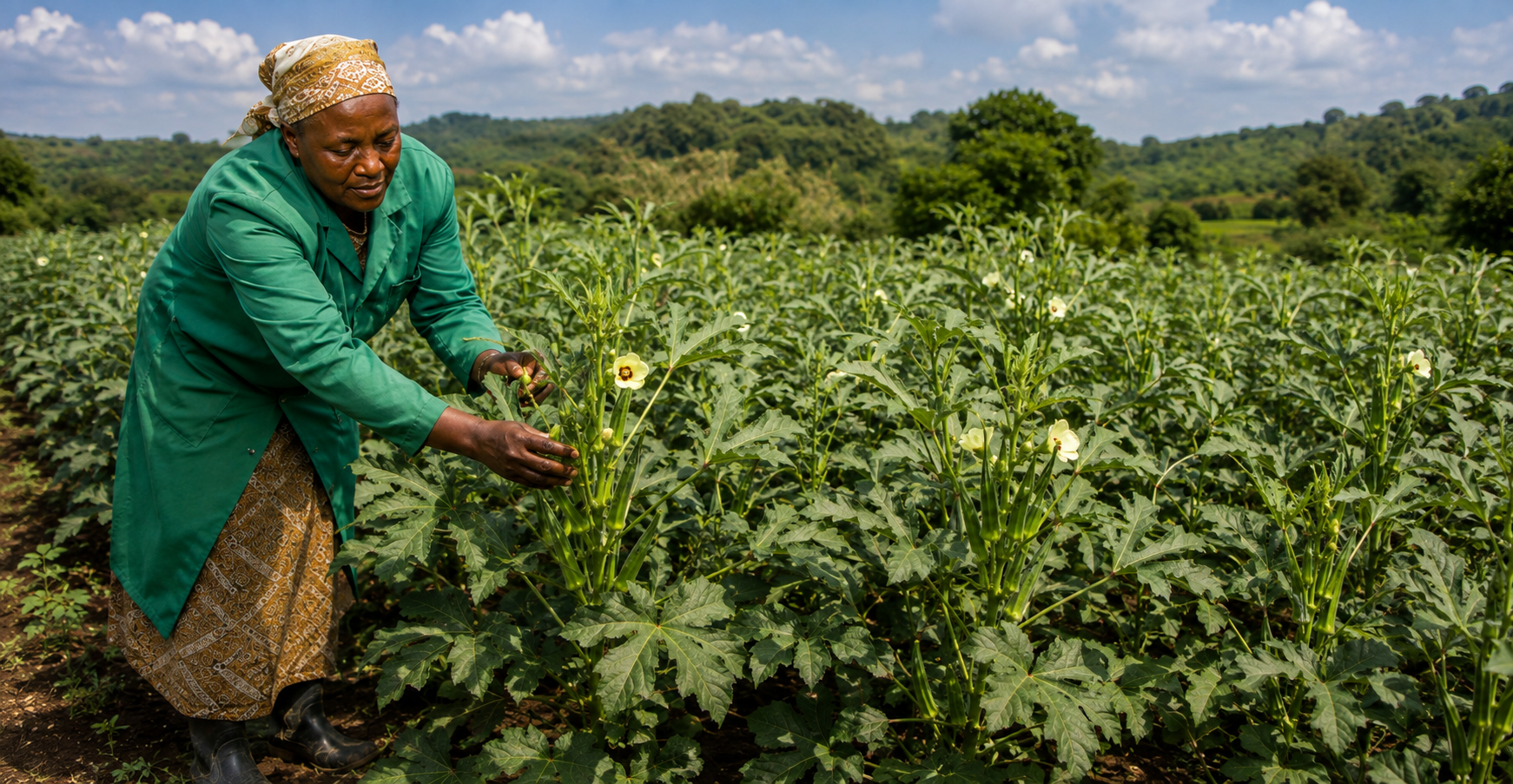
In the villages of Gumbu and Mayephu in Limpopo, a traditional vegetable is demonstrating how an underutilised crop can support household food security, create income and connect smallholder farmers with urban markets. Okra’s ability to tolerate heat, perform under relatively low rainfall and produce over an extended harvesting period adds a robust agricultural dimension to a crop that has been hiding in plain sight.
In the fields of northern Limpopo, a familiar green vegetable is beginning to tell a much bigger agricultural story. Okra has been cultivated in local communities for many years, yet its role in South Africa’s formal agricultural sector remains comparatively small. What farmers in Gumbu and Mayephu are demonstrating, however, is that a traditional crop does not have to be one of the country’s dominant commercial vegetables to create meaningful value.
Okra (Abelmoschus esculentus) combines several characteristics that make a robust case for renewed attention. It is a warm-season crop, tolerates high temperatures, performs relatively well under low-rainfall conditions and can continue producing pods over an extended harvesting period. At the same time, farmers are selling fresh produce into local and urban markets, creating an important connection between rural production, household nutrition and supplementary income.
This does not mean that okra is suddenly competing with South Africa’s major agricultural crops. The significance is more measured than that. Its story shows how a robust agricultural system can include crops that have sustained communities for generations but have historically received less attention from formal research, extension systems, policymakers and mainstream markets.
For farmers facing an increasingly demanding production environment, that is a conversation worth having.
An African Crop With Modern Relevance
Okra is believed to have originated in Africa and is widely consumed across the continent, as well as in Asia, the Caribbean and parts of the Americas. Its young green pods are commonly used in soups, stews and vegetable dishes, while the leaves and seeds can also be utilised for food and other purposes.

Despite this long history, okra remains largely underutilised within South Africa’s formal agricultural sector. Commercial vegetable production tends to concentrate on crops such as tomatoes, cabbages, spinach, onions and potatoes. Indigenous and traditional vegetables often occupy a less prominent position in research programmes, agricultural policy discussions and mainstream produce markets.
The experience of okra suggests that underutilisation should not automatically be confused with lack of value. A crop can have a relatively small formal commercial footprint while still providing a robust combination of nutritional, agricultural and economic benefits at community level.
This is particularly evident in farming systems where crop choice must respond to more than yield alone. Farmers also have to consider climatic conditions, production inputs, harvesting patterns, household requirements and whether there is a market for what they grow.
Okra brings several of those considerations together.
The crop tolerates high temperatures and performs relatively well where rainfall is low. Compared with many commercial vegetables, it requires fewer inputs, while its ability to continue producing pods over an extended harvesting period provides farmers with repeated harvesting opportunities.
These characteristics create a robust foundation for considering okra as part of more diversified agricultural systems, particularly in drought-prone areas where smallholder farmers need crops capable of operating within difficult production environments.
Gumbu and Mayephu: Where Tradition Meets the Market
The villages of Gumbu and Mayephu provide a practical example of what this potential can look like.
Gumbu is situated in the Musina Local Municipality, while Mayephu is located in the Collins Chabane Local Municipality. Farmers in these communities have cultivated okra for many years as part of local food traditions. In more recent years, however, there has been growing recognition of the crop’s commercial value.
This change is important because production is no longer limited to household consumption. Farmers are increasingly growing okra for sale to local traders, community markets and urban buyers.
That creates a robust link between traditional production and a wider commercial opportunity.
During the harvesting season, fresh okra harvested from village fields moves beyond Limpopo and reaches markets in Johannesburg and Pretoria. Consumers from different cultural backgrounds actively seek the vegetable, helping create demand for produce grown in rural communities hundreds of kilometres away.
For smallholder producers, access to such markets can transform the role of a crop. Okra remains part of household food traditions, but it can simultaneously become a source of supplementary income.
The significance of that income is reinforced by the crop’s harvesting characteristics. Okra can be harvested repeatedly over several weeks or months, enabling farmers to generate regular cash flow throughout the production season rather than depending solely on a single harvest.
That creates a more robust commercial rhythm for participating households. Each harvest provides another opportunity to supply a trader, serve a community market or sell directly to consumers.
Local traders often buy fresh pods directly from producers. This can reduce some of the marketing challenges farmers might otherwise encounter and allows them to concentrate more closely on production. Other farmers sell directly within their communities, ensuring that locally produced vegetables remain available to local households.
The result is a crop serving both sides of the rural food economy: it can feed the household and community while also generating income.
A Niche Crop Does Not Mean a Weak Market
One of the most important lessons emerging from the Limpopo experience is that crops do not necessarily need to become mainstream before they can become profitable.

Urbanisation and increasing cultural diversity in South Africa have contributed to demand for traditional vegetables, including okra. Consumers from various African countries, together with South African communities that have a long tradition of eating the vegetable, actively seek fresh okra.
Johannesburg and Pretoria have consequently become important destinations for produce grown in Limpopo. Fresh-produce traders recognise its value and source supplies from rural producers during peak production periods.
This represents a robust reminder that agricultural markets can exist at different scales.
For a smallholder farmer, the most important question is not necessarily whether a crop dominates supermarket shelves nationally. What matters is whether there is genuine demand from buyers and whether production can reach those buyers.
Niche markets can therefore provide significant opportunities when farmers align production with consumer demand.
The okra trade between rural Limpopo and urban Gauteng illustrates exactly this point. An underutilised crop can remain comparatively small in national agricultural terms while still providing a robust economic opportunity for individual producers and communities.
That distinction is important. Agricultural development does not always have to begin by identifying the next massive commodity. Sometimes meaningful progress can come from strengthening smaller existing value chains that already connect farmers and consumers.
Nutrition Inside the Green Pod
Okra’s value is not limited to production and markets. The vegetable also offers a robust nutritional profile.
Fresh okra is low in calories and fat while providing useful dietary fibre. It is a source of vitamin C, vitamin K, folate, calcium, magnesium and potassium. It also contains mucilaginous soluble fibre, responsible for the characteristic texture released during cooking, and contains various bioactive compounds and antioxidants, including polyphenols and flavonoids.
The nutritional composition of 100 grams of fresh okra contains approximately 33 kcal of energy, 3.2 g of dietary fibre and 1.9 g of protein.
It also provides approximately 23 mg vitamin C, 82 mg calcium, 57 mg magnesium, 299 mg potassium, 60 µg folate, 31 µg vitamin K and 0.6 mg iron.
These nutrients perform different roles in the diet. Dietary fibre supports healthy digestion, while protein contributes to plant-based protein intake. Vitamin C supports immunity and antioxidant protection, and calcium is important for strong bones and teeth.
Magnesium supports muscles and normal metabolism, potassium helps maintain normal fluid balance and muscle function, folate is important for cell growth and development, vitamin K supports blood clotting and bone health, and iron is essential for healthy blood formation.
Taken together, these characteristics provide a robust nutritional argument for maintaining traditional vegetables within diverse diets.
The crop’s characteristic mucilage — the gel-like substance released when okra is cooked — is valued for its culinary properties and has been associated with various health benefits.
For rural communities where access to a wide range of vegetables may sometimes be limited, regular consumption of okra can contribute to improved nutrition and dietary diversity. In areas where malnutrition and micronutrient deficiencies remain challenges, nutrient-rich traditional crops could therefore contribute to healthier diets.
This brings the story back to a central strength of okra: the same crop that can be sold for income can also remain part of the household food system.
Climate Resilience Gives Okra Another Role

Okra becomes particularly relevant when considered against changing climatic conditions.
Climate scientists predict that many parts of South Africa will experience higher temperatures, more frequent droughts and greater rainfall variability in coming decades. Such conditions pose risks to conventional crops requiring substantial water and external inputs.
Under these circumstances, crops capable of coping with periods of heat and water stress may become increasingly important within a robust and diversified farming system.
Farmers in Gumbu and Mayephu have long observed okra’s ability to withstand periods of heat and water stress better than many other vegetables. That practical experience does not mean the crop is drought-proof, and the distinction is important. No crop is completely immune to drought.
Okra’s natural resilience does, however, make it an attractive option for climate-smart agriculture.
Its ability to tolerate high temperatures, perform relatively well under low-rainfall conditions and continue producing pods over an extended period creates a robust combination of characteristics for smallholder production in drought-prone areas.
The argument for okra is therefore not based on a single feature. Its relevance comes from the way several features intersect: adaptability, nutrition, repeated harvesting, market demand and local familiarity.
Together they make a robust case for agricultural diversification.
Diversification does not mean removing the major crops on which South Africa depends. Rather, it means recognising that a wider range of crops can have roles within different farming systems and markets.
Okra already occupies such a role in communities where it has been cultivated for generations.
The Opportunity Is Clear, but So Are the Constraints
Potential alone does not automatically result in larger-scale production.
Despite okra’s positive attributes, several challenges continue to limit wider adoption in South Africa. The authors identify four particularly important areas: limited research and extension support, seed availability, market constraints and perceptions surrounding traditional crops.
Addressing these challenges would be necessary to create a more robust environment for future production.
Compared with major commercial crops, relatively little research has been conducted in South Africa on okra varieties, agronomic practices, pest management and market development.

This matters because commercial expansion requires knowledge. Farmers need access to appropriate production information, while extension systems need sufficient understanding of the crop to support producers effectively.
A more robust research base could strengthen knowledge around an agricultural product that already has farmers, consumers and existing markets.
The second challenge is seed.
Many farmers rely on farmer-saved seed or informal seed systems. Importantly, these systems play a crucial role in conserving locally adapted varieties. They should therefore not simply be dismissed as inadequate.
At the same time, improved access to quality seed could help increase productivity.
The opportunity lies in developing robust seed systems that recognise the value of locally adapted material while also improving farmers’ access to quality planting material.
Markets Still Need Development
Although there is demand for okra, market channels remain underdeveloped.
Many farmers lack access to reliable buyers, suitable storage facilities and transportation systems. These practical constraints can limit the ability of producers to translate agricultural potential into commercial success.

The existing connections with Johannesburg and Pretoria show that markets are available, but strengthening those channels would provide a more robust platform from which farmers could develop production.
Market development becomes especially important for a fresh crop. Farmers can grow good produce, but that produce still needs to move from field to buyer.
Reliable traders, transport and appropriate storage therefore form part of the wider agricultural picture.
The relationship between farmers and local traders in Gumbu and Mayephu already demonstrates one mechanism through which these constraints can be reduced. When traders purchase pods directly from farmers, producers have a clearer route to market.
Building on such connections could create a robust value chain capable of supporting more farmers while maintaining access to consumers.
The Perception Problem
The fourth barrier may be less physical than poor roads, limited storage or unavailable seed, but it can be just as influential.
Traditional and indigenous crops are sometimes perceived as “poor people’s food”, despite their nutritional and economic value.
Such perceptions can restrict consumer demand and prevent crops from achieving wider recognition.
Creating a robust future for okra therefore also requires a change in how traditional foods are viewed.
A vegetable does not lose nutritional value because it has been cultivated by rural communities for generations. Nor does a crop become commercially irrelevant simply because it has historically sat outside the mainstream produce sector.
The experiences in Limpopo challenge precisely that assumption.
Farmers are producing okra commercially. Traders are purchasing it. Urban consumers are looking for it. Households are eating it.
That is already a robust foundation from which perceptions can begin to change.
Strengthening the Whole System
Unlocking okra’s full potential requires progress across several connected areas rather than a single intervention.
Research must improve. Seed systems need strengthening. Markets need development. Consumer perceptions need to evolve.
A robust approach would recognise that these areas depend on one another.
Research without markets will not automatically create farmer income. Market demand without reliable production cannot build a dependable value chain. Better seed without appropriate knowledge and market access solves only part of the problem.
The opportunity lies in strengthening the entire system around the crop.
Investment in research, seed systems, value-chain development and market promotion could help move okra from its current niche position towards a more important contribution to rural livelihoods and agricultural resilience.
The success already being demonstrated by farmers in Gumbu and Mayephu provides a robust starting point.
They are not waiting for an entirely new crop to arrive.
They are working with one that communities already know.
Underutilised Does Not Mean Unimportant
The broader lesson reaches beyond okra.
As policymakers, researchers and development organisations seek solutions to food insecurity, climate change and rural poverty, greater attention can be given to crops that have sustained communities for generations.
A robust agricultural future may depend not only on introducing new technologies or unfamiliar crops, but also on recognising the potential of agricultural diversity that already exists.
The experiences of Limpopo farmers demonstrate this clearly.
Innovation does not always require introducing something new. Sometimes it means rediscovering value that has been overlooked, strengthening production systems around it and creating better connections between producers and markets.
Okra represents a robust example of that possibility.
Its cultivation is already familiar. There is existing consumer demand. Local and urban markets are already buying produce. Farmers can harvest repeatedly during the production season. The crop also contributes to household nutrition.
The challenge is to build on those existing strengths.
A Green Pod With a Bigger Future
Okra may not yet hold the same position in South African agriculture as maize, tomatoes or potatoes. There is no need to pretend otherwise.

Its opportunity lies in something different.
In villages such as Gumbu and Mayephu, farmers are demonstrating that traditional crops can generate income, strengthen food security and connect rural communities with urban markets.
This creates a robust reminder that agricultural value should not always be measured only by the size of a national commodity.
For the households growing okra, the crop can provide food and recurring seasonal income. For traders, it provides a product demanded by specific markets. For consumers, it offers a familiar and nutritious vegetable. For agricultural systems seeking greater diversity, it provides another production option.
Those roles together create a robust agricultural story.
South Africa’s agricultural future will continue to depend heavily on modern technologies, research, established commercial crops and sophisticated production systems. But that future may also depend on recognising the rich diversity of crops already growing in the country’s fields.
As climate pressures intensify and farmers continue searching for production systems capable of coping with difficult conditions, the role of crops such as okra deserves closer attention.
A robust future for this crop will require research, stronger seed systems, better market development and changing perceptions. None of these challenges should be underestimated.
Yet the starting point is already visible.
Farmers are growing the crop. Consumers are eating it. Traders are buying it. Rural communities understand it. Urban markets are receiving it.
That is a robust platform on which to build.
The green pods growing in the fields of Gumbu and Mayephu may therefore represent something larger than an underutilised vegetable. They illustrate how traditional crops can form part of a more diverse, sustainable and food-secure agricultural future.
Sometimes agricultural opportunity arrives through a new technology or a new production system.
And sometimes a robust opportunity has been growing quietly in the field all along.
5 Questions & Answers About Okra
1. Why is okra considered a climate-smart crop?
Okra tolerates high temperatures, performs relatively well under low-rainfall conditions and requires fewer inputs than many commercial vegetables. Farmers in Gumbu and Mayephu have also observed its ability to withstand periods of heat and water stress better than many other vegetables. No crop is completely immune to drought, but these characteristics provide a robust basis for considering okra within climate-smart and diversified agricultural systems.
2. Can smallholder farmers make money from okra?
The experiences of Gumbu and Mayephu show that okra can provide supplementary household income. Farmers sell to local traders, community markets and urban buyers, while produce from Limpopo reaches markets in Johannesburg and Pretoria. Because pods can be harvested repeatedly over several weeks or months, the crop can provide a robust pattern of regular cash flow during the production season.
3. What nutritional value does fresh okra provide?
Fresh okra provides dietary fibre, protein, vitamin C, calcium, magnesium, potassium, folate, vitamin K and iron. It also contains mucilaginous soluble fibre and various bioactive compounds and antioxidants, including polyphenols and flavonoids. This gives the vegetable a robust nutritional profile and allows it to contribute to healthier and more diverse diets.
4. What is preventing wider okra production in South Africa?
The main challenges identified are limited research and extension support, access to quality seed, underdeveloped market channels and perceptions surrounding traditional crops. Farmers may also lack reliable buyers, storage and transport. Addressing these areas together could create a more robust environment for expanding production and improving market access.
5. What could help unlock the potential of okra?
Greater research, improved seed systems, stronger market development and changing consumer perceptions could help unlock the crop’s potential. Investment in these areas could provide a more robust value chain and help okra make a larger contribution to rural livelihoods, nutrition, agricultural diversity and resilience in South Africa.
Written by M.O based on the Paper written:
By Dr Lehlogonolo Matelele*,
Mr Sithembiso Fakude,
Ms Nkat Maluleke and
Ms Precious Sema
National Department of Agriculture, Directorate Genetic Resources, National Plant Genetic Resources Centre
*Correspondence:
LehlogonoloMa@nda.gov.za / matelelela@gmail.com