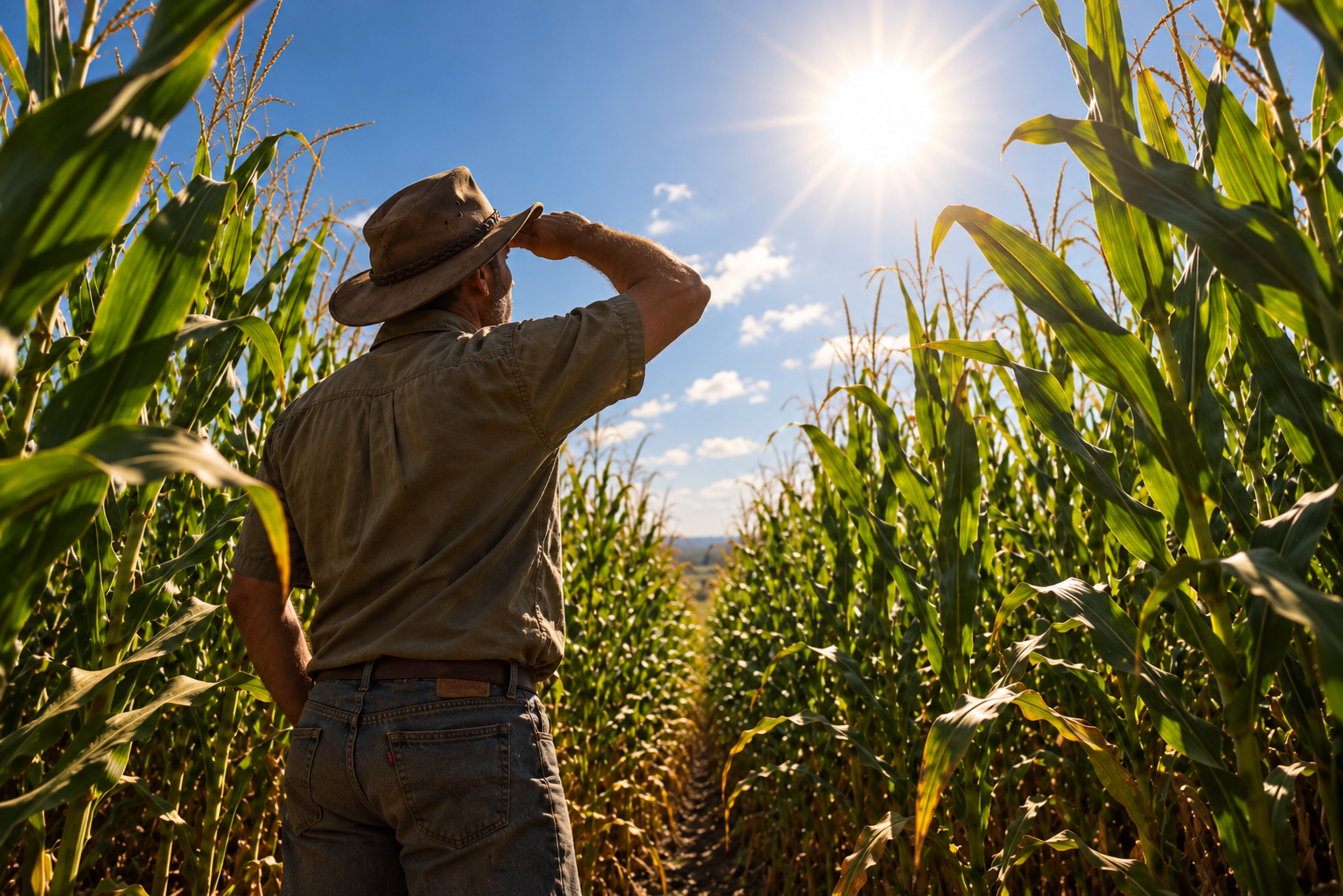
South Africa is entering the 2026/27 summer production season from a position that would normally inspire confidence. The country has just produced an exceptional maize crop, commercial stocks are comfortable, exportable supplies are substantial and much of the summer-rainfall region begins spring with far better soil-moisture reserves than it carried into some previous drought cycles. Yet the timing could hardly be more awkward. Super El Niño is strengthening over the tropical Pacific just as farmers prepare to plant the crop that must eventually replace the grain now filling South African silos.
That contradiction is at the heart of the coming season. Super El Niño does not mean South Africa is facing an immediate maize shortage, nor does it guarantee that the 2026/27 crop will fail. What it does mean is that a country enjoying one of the strongest grain buffers in its history is about to test that buffer under a far less certain climate regime. If South African production weakens materially while neighbouring countries and major international producing regions suffer at the same time, today’s surplus could acquire a value far beyond what its present abundance suggests.
The World Meteorological Organization confirmed on 3 September 2026 that El Niño is firmly established and is expected to intensify into a very strong event before peaking towards the end of the year. WMO forecasts indicate a near-100% likelihood that the event will persist through February 2027, supported by exceptionally warm conditions across the tropical Pacific.
The description “Super El Niño” is not WMO’s formal scientific classification. It is an increasingly common way of describing the exceptional strength of the current event — Reuters has also referred to the emerging phenomenon as a “supersized” El Niño — but in technical terms WMO describes it as developing towards very strong intensity.
That distinction matters. The agricultural implication is not that drought is inevitable everywhere. It is that the probabilities surrounding rainfall, heat and production risk have shifted sufficiently to demand unusually careful preparation.
South Africa’s record harvest changes the starting point
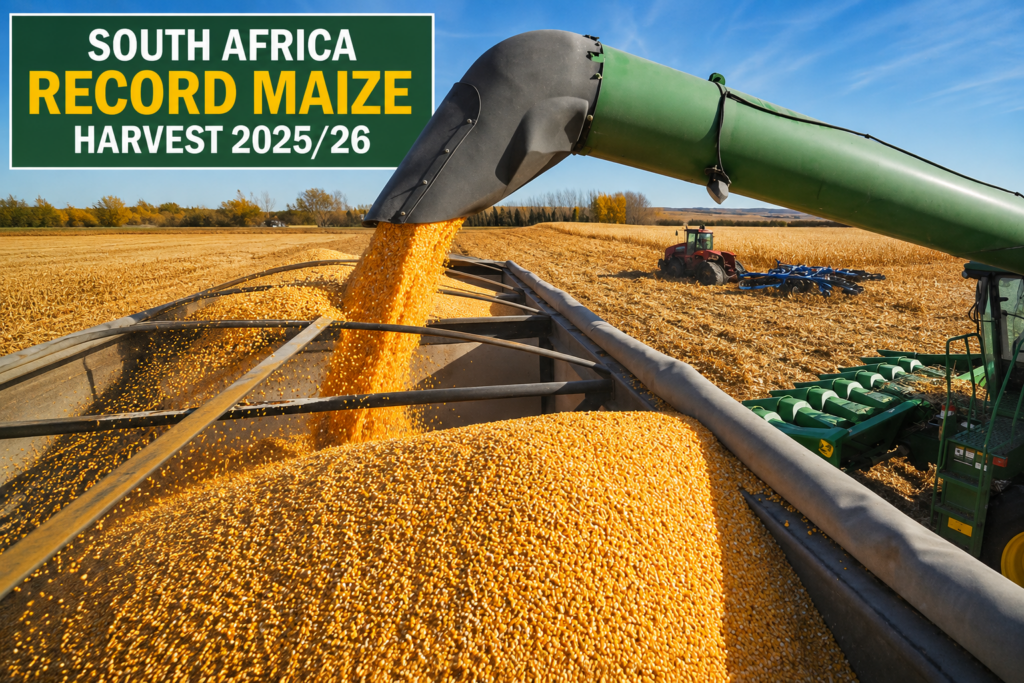
South Africa could scarcely have asked for a better grain position from which to enter such an uncertain period.
In the Sept/Oct 2026 edition of Nufarmer Africa, Vol. 30 No. 5, page 2, the magazine reported that South Africa was on course for a commercial maize harvest of approximately 17.3 million tonnes, supported by excellent summer rainfall, expanded plantings and outstanding yields. At the time, annual domestic maize consumption was estimated at around 12 million tonnes, leaving the country with a considerable exportable surplus.
The Crop Estimates Committee subsequently issued its seventh production forecast on 26 August, confirming that the 2026 summer crop remained at historic levels.
This abundance means South Africa enters Super El Niño with exactly what every grain-producing country would want before a dangerous climate season: physical stocks, productive capacity, improved soil moisture and time to observe what happens next.
That starting position separates South Africa from many African countries entering the same global weather cycle with much smaller margins for error. South Africa is not coming into Super El Niño after a failed harvest. It is entering it after a record one.
A significantly smaller 2027 harvest would therefore not automatically translate into an immediate national maize shortage. Existing stocks can provide protection. The more difficult question is how much of that protection South Africa could ultimately need before the next substantial crop is safely inside the silo.
There is an enormous difference between grain already harvested and grain that currently exists only on a production plan. The maize South Africa has today was produced during a wet 2025/26 season. The crop farmers are preparing to plant from October will have to establish and develop while Super El Niño approaches peak intensity.
That is where the apparent security of the current crop becomes less certain.
South Africa has a head start — not immunity
The preceding wet production season left much of South Africa’s summer-rainfall region in better condition than it carried into some previous drought cycles. The Department of Agriculture noted this week that above-normal rainfall during 2025/26 improved both dam levels and soil moisture across most summer-rainfall areas. At the same time, the South African Weather Service expects El Niño to continue through the 2026/27 summer and warns of many areas of below-normal rainfall associated with the event, together with high temperatures and the risk of heat stress.
This is one reason there is a reasonable argument that South Africa may withstand Super El Niño better than several neighbouring countries.
The Sept/Oct 2026 edition of Nufarmer Africa, Vol. 30 No. 5, page 89, addressed precisely this dilemma under the headline South Africa May Weather El Niño — But Can Southern Africa? The article pointed to the country’s record maize harvest, healthier grain stocks, improved soil moisture and stronger water position compared with the circumstances preceding the devastating 2015/16 drought.
Yet none of those advantages makes South African maize production drought-proof.
Saai’s 3 September warning adds an important agricultural qualification. Improved soil moisture may help producers establish crops at the beginning of the season, but production thereafter will depend heavily on early-season rainfall and subsequent weather.
That is particularly significant in a country where the majority of summer grain production remains dependent on rainfall.
A farmer can begin Super El Niño with useful moisture stored below the surface and still end the season with a disappointing crop if repeated rainfall fails at critical growth stages or excessive temperatures raise crop-water demand.
The value of the current soil-moisture advantage should therefore be understood correctly. It can buy the crop time. It cannot substitute for an entire summer rainfall season.
Saai board chair Dr Theo de Jager’s warning that farmers should not take unnecessary chances on marginal land is therefore especially relevant. The 2026/27 season will require careful judgement over planting decisions, production potential, exposure to input costs and the amount of financial risk producers are prepared to carry.

Super El Niño does not remove farmers’ ability to manage risk. It makes the consequences of poor risk management potentially greater.
The real concern lies beyond the current harvest
The question South Africa should be asking is not whether the country has enough maize in September 2026.
It does.
The more uncomfortable question is what the national maize balance could look like towards the end of the 2027 production cycle if the next harvest disappoints while current stocks have simultaneously been reduced through domestic consumption and exports.
No responsible agricultural journalist can say today that Super El Niño will cause a South African maize shortfall in 2027. The crop has not yet been planted, and a seasonal climate forecast cannot simply be converted into a tonnage estimate.
What can be said is that the downside risk has increased enough for a substantially smaller crop to form part of food-security planning now.
Historical experience explains why.
During the 2015/16 El Niño drought, Southern African production contracted severely and the region eventually had to source maize from as far away as Mexico. The Sept/Oct 2026 edition of Nufarmer Africa, Vol. 30 No. 5, page 99recalled that episode in considering the implications of another severe regional production shock.
Conditions are more favourable today because South Africa has a much stronger buffer.
But if Super El Niño materially reduces the crop harvested in 2027, part of what currently looks like surplus maize could suddenly look more like strategic carry-over.
That does not mean South Africa should stop exporting maize now. A record crop needs export demand. Without it, domestic oversupply can push producer prices sharply lower and weaken the financial ability of farmers to plant the next crop.
The issue is one of timing and balance.
Every tonne exported today generates income and relieves domestic surplus. Every tonne carried into 2027 potentially provides insurance against a weaker crop. As the season progresses, the appropriate balance between those two functions will have to be reassessed continuously.
Africa may need South Africa before South Africa knows its own outcome
The regional situation makes that calculation even more complicated.
Zimbabwe, Botswana and Namibia have already been buying South African grain. As Nufarmer Africa, Sept/Oct 2026, Vol. 30 No. 5, page 89 pointed out, that demand is notable because it emerged relatively soon after the region’s preceding production season. It suggests that some neighbouring countries are entering the new climate cycle with thinner domestic buffers than South Africa.
The SADC regional climate outlook now favours below-normal rainfall across much of the central and southern part of Southern Africa for October–December 2026. The areas affected include southern Zambia, Zimbabwe, Mozambique, Namibia, Botswana, most of South Africa, Eswatini and Lesotho. The drier signal is expected to persist over substantial parts of the region as the rainy season progresses, while above-average temperatures are favoured across most of SADC.
This is where Super El Niño begins to look less like an individual-country production problem and more like a regional food-security test.
The danger is not that every country will fail. The danger is that several countries could need additional grain at approximately the same time.
One poor harvest can usually be accommodated through trade. A deficit country buys from a surplus country and grain moves towards the market where it is needed.
If several African countries suffer simultaneously under Super El Niño, however, the same available tonne begins attracting several potential buyers.
South Africa’s record harvest then assumes a completely different strategic significance. Grain originally described as an exportable surplus becomes part of a wider African food-security buffer.
Kenya provides an early warning
Kenya demonstrates how quickly a producing country can move from disappointment in the field to substantial demand in the import market.
The Sept/Oct 2026 edition of Nufarmer Africa, Vol. 30 No. 5, page 70, reported that adverse weather had damaged Kenya’s maize harvest and that production could decline sharply. At the time, an expected deficit of approximately 5.4 million 90 kg bags, equivalent to around 486,000 tonnes, was being discussed.
The situation has subsequently broadened. On 19 August, Kenya News Agency reported that the government intended to facilitate imports of 25 million 90 kg bags of maize to bridge a much wider anticipated national supply deficit following drought and climate-related production problems.
Kenya’s current production difficulties should not simply be described as the result of the same Super El Niño effects expected in Southern Africa. Climate impacts differ by geography, and East Africa does not necessarily respond to El Niño in the same way as the Southern African summer-rainfall region.
What Kenya does demonstrate is how quickly a national balance sheet can change.
A country can move from growing maize to actively seeking millions of bags on international and regional markets within a single poor production period.
If Super El Niño causes similar transitions across several countries, Africa will no longer simply be redistributing comfortable regional surpluses. It will increasingly be competing for them.
The continuation of the Kenya article in Nufarmer Africa, Sept/Oct 2026, Vol. 30 No. 5, page 103 makes the wider point particularly clearly: a production failure in one country can often be compensated for through trade, but the danger increases when several producing regions encounter difficulties simultaneously.
What if the Northern Hemisphere is also under pressure?
Africa does not operate within a closed grain system.
South African maize remains an internationally traded commodity, and the global consequences of Super El Niño could therefore influence South African food prices even if local production performs better than feared.
There is no evidence at present that the world is facing an imminent general grain famine. Modern agriculture is better protected by improved yields, larger inventories, better forecasting, irrigation, crop science and a wider range of major exporters than it was during some previous severe El Niño periods. Reuters reported in August that substantial global inventories and improvements in agricultural productivity have strengthened the world food system’s ability to absorb the developing shock.
That reassurance should not become complacency.
Parts of the Northern Hemisphere are already showing signs of agricultural stress. The European Union’s 2026 maize crop is forecast at approximately 50.1 million tonnes, close to a two-decade low and about one-fifth below the recent three-year average. Drought, extreme heat and water shortages have severely affected traditional maize-producing areas in Hungary and Romania, with Hungary expected to import maize rather than operate as its traditional exporter.
India also entered September after rainfall in August finished about 16% below normal. Below-average September rains are expected, raising concerns for summer crops including maize, soybeans and pulses as they move through important development stages.
Central America’s Dry Corridor is already experiencing severe crop losses, with more than 70,000 maize-growing households reporting devastating failures across parts of Guatemala, Honduras and El Salvador.
These developments should not all be lumped together as proof that Super El Niño is about to collapse global maize production. Different regions face different combinations of El Niño, longer-term climate pressures and local weather.
Their importance lies elsewhere.
They demonstrate what happens when several normally productive regions enter international grain markets with reduced output or increased import requirements.
When a South African surplus acquires a dollar value
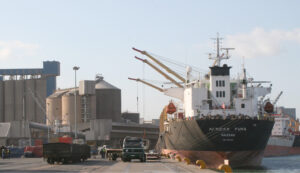
A record South African maize crop normally exerts downward pressure on local prices because supply exceeds domestic requirements. Exports are therefore essential. They remove excess stock, support producer prices and enable South African farmers to continue producing at commercial scale.
The complication arises if Super El Niño tightens global grain availability at the same time that South Africa is sitting on substantial exportable maize.
The value of grain in a Free State or North West silo is not determined purely by the amount South Africans consume. Export parity, international prices, freight and the rand-dollar exchange rate all matter.
This was a central theme of the article beginning on page 89 and continuing on page 99 of Nufarmer Africa, Sept/Oct 2026, Vol. 30 No. 5. The magazine warned that South Africa could have sufficient physical grain and still experience substantially higher food and animal-feed prices because its maize remains connected to international commodity markets.
If Super El Niño severely damages crops elsewhere, international buyers could be prepared to pay more for available maize.
That does not make exports undesirable. Farmers must recover enormous costs for fertiliser, fuel, machinery, finance, electricity and labour. Without viable markets, South Africa will weaken the productive capacity it may desperately need in the following season.
But the market creates an uncomfortable food-security paradox.
The country can have maize in its silos while the value of that grain is increasingly determined by buyers thousands of kilometres away.
The physical grain is South African.
Its price can be global.
Food security requires caution before it requires intervention
This is why food-security planning cannot begin when supermarket prices have already surged or when a crop has already failed.
Super El Niño requires greater surveillance of South Africa’s grain balance, not immediate panic.
Premature export restrictions would risk undermining farm prices, disturbing trade relationships and interfering with a grain market that currently has more than adequate supply. Such action could ultimately damage the producers South Africa needs to remain productive.
The more rational approach is to manage the national surplus dynamically.
Government and industry should know how much white and yellow maize remains in stock, how much has been contracted for export, what domestic consumption is absorbing, how regional demand is evolving and, crucially, how the developing crop is performing.
If South Africa receives adequate summer rainfall and crop prospects remain strong, the export programme can continue with confidence.
If Super El Niño brings delayed planting, extreme heat and widespread moisture stress, the prudent volume of maize carried into the following marketing period may need to increase.
The calculation that is sensible in September 2026 may not be the calculation that is sensible in February 2027.
That is not government hoarding.
It is ordinary agricultural risk management applied to an extraordinary climate situation.
South Africa’s GM maize creates another complication
There is another factor that becomes increasingly important when maize is considered as an African food-security buffer.
Most South African commercial maize is genetically modified.
The South African National Biodiversity Institute reported in 2023 that more than 85% of South African maize production is GM. OECD data separately estimated the GM share of South Africa’s maize area at 84.5% in 2021/22, including a particularly high share of white-maize plantings.
South Africa can therefore have millions of tonnes available while some potential importing countries cannot necessarily receive every tonne under their existing regulatory systems.
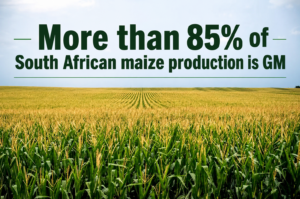
African countries follow very different biotechnology policies. Some permit approved GM crops, while others apply restrictions or require specific biosafety approvals and documentation before genetically modified maize can enter the country.
Under normal conditions, buyers with restrictions can insist on non-GM maize and source accordingly.
A severe Super El Niño food-security crisis could make that choice considerably more expensive.
Could food shortages force a rethink of GMO restrictions?
Kenya again provides a useful example of the regulatory complexity.
The Kenyan government announced in October 2022 that it was lifting its earlier GMO prohibition, including authorising the open cultivation and importation of white GM maize. The matter subsequently became subject to extensive litigation. In March 2025, Kenya’s Court of Appeal issued an injunction preserving the status quo and restraining further government action aimed at permitting GMO crops and food while an appeal was pending.
Kenya’s biosafety framework also requires a person seeking to import a genetically modified organism to obtain written approval from the National Biosafety Authority.
That creates a fascinating food-security question.
What happens if Super El Niño leaves large parts of Africa requiring maize, non-GM supplies tighten and substantial South African GM stocks remain available relatively nearby?
It would be speculative to state that countries with GMO restrictions will lift them.
They may not.
National decisions around biotechnology involve biosafety, law, public opinion, domestic politics and agricultural policy.
But a serious shortage could place those restrictions under pressure in a way that normal market conditions do not. Governments might be asked to accelerate risk assessments, approve specific GM events, create temporary emergency arrangements or reconsider restrictions where legally possible.
When food is plentiful, regulatory debates can remain theoretical.
When food becomes scarce and expensive, they become immediate.
If Super El Niño results in a genuine threat of famine in vulnerable areas, the question confronting some governments may ultimately be less philosophical: whether maintaining restrictions on available GM maize is worth the additional food-security risk.
White maize deserves particular attention
The discussion also needs to distinguish between white and yellow maize.
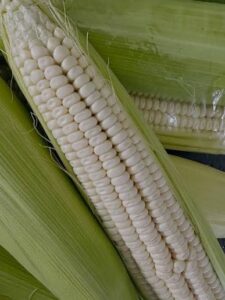
White maize is particularly important for direct human consumption in South Africa and across parts of the continent. Yellow maize, meanwhile, is heavily used in animal-feed industries, meaning shortages can feed into poultry, eggs, dairy and meat prices even before consumers feel the effect directly through maize meal.
A national production total can therefore conceal important differences inside the grain balance.
If Super El Niño tightens supplies, policymakers will need to know not simply how many tonnes of maize remain, but which maize remains, where it is stored, whether it is already committed, whether it is GM or non-GM and which regional markets are legally able to receive it.
Those details can determine whether a theoretical regional surplus is actually usable.
Africa could conceivably have maize available on the continent while a country facing a shortage struggles to access the right grain at the right price under its regulatory framework.
That is a food-security problem every bit as real as insufficient production.
South Africa can support Africa, but it cannot carry Africa indefinitely
South Africa has an important role as a regional supplier, particularly if Super El Niño weakens production across Southern Africa.
But the country’s record harvest is not limitless.
South Africa must feed its own population, supply its milling industry, sustain its poultry and livestock sectors, maintain commercially viable markets for grain producers and carry enough stock into the period before the 2027 harvest becomes available.
Regional responsibility therefore cannot be separated from domestic responsibility.
Three million tonnes of exportable maize can appear enormous when one country needs a few hundred thousand tonnes.
The same surplus looks much smaller if several countries simultaneously require large imports while global buyers are also competing for grain.
That is why this season should not become an argument between exporting and retaining maize. Both are necessary.
The task is to recognise the point at which the balance changes.
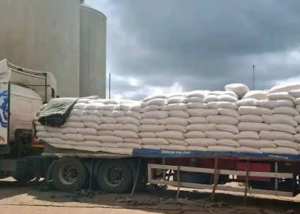
The record harvest may ultimately be remembered as insurance
South African farmers deserve to celebrate the crop they have produced.
A harvest of roughly 17.4 million tonnes represents an extraordinary agricultural achievement and provides the country with a degree of protection that many African economies would envy.
But Super El Niño changes the context in which that achievement must now be understood.
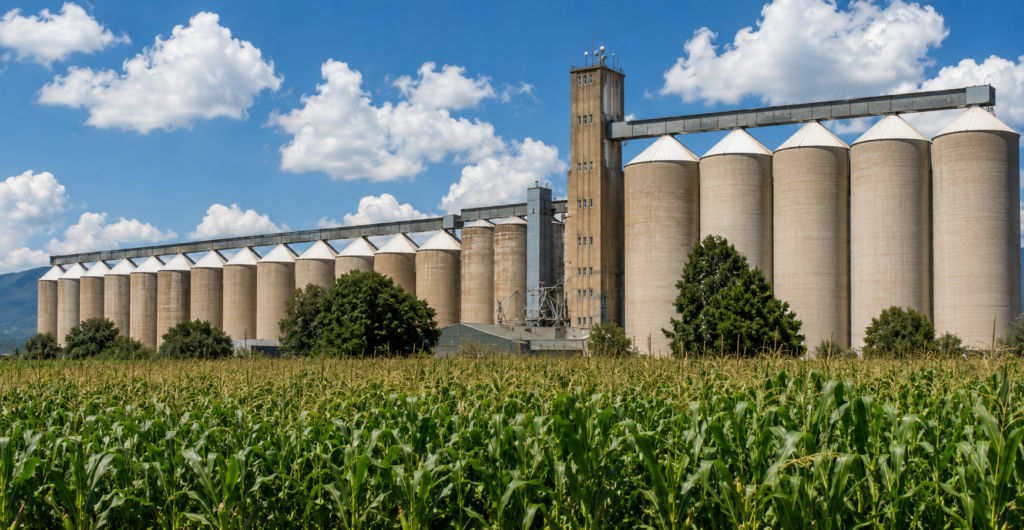
The maize sitting in South African silos was produced under favourable conditions that may not be repeated during the crop that follows.
If rainfall remains adequate and the 2027 harvest performs well, South Africa may pass through Super El Niño with its grain position largely intact. The present surplus can then continue doing what a surplus should do: supplying domestic markets, supporting regional food security and earning export revenue.
If the crop disappoints, the same stocks become insurance.
If South Africa and several neighbouring countries experience major production losses simultaneously, they become regional insurance.
And if Super El Niño also damages important Northern Hemisphere and global production regions, those stocks become an internationally sought-after commodity priced in a market where South African consumers may be competing indirectly with considerably wealthier buyers.
This is where the warning contained in Nufarmer Africa, Sept/Oct 2026, Vol. 30 No. 5, page 99 deserves to be repeated. Food security cannot be measured simply by the tonnes sitting inside a silo. It also depends on whether the people who need that grain can afford what is inside it.
South Africa therefore enters the coming season with an advantage, but not immunity. Its record harvest has bought the country something immensely valuable: breathing space.
Using that breathing space wisely may prove as important as producing the crop itself.
The defining agricultural question of the months ahead is not whether South Africa has maize today. It unquestionably does.
It is how much of that maize South Africa may need tomorrow, how much Africa may require from the same stocks, and what the world might be willing to pay for them if Super El Niño turns several major crop-producing regions from sellers into buyers at the same time.
(M.O)