South Africa’s seed industry depends on trust, traceability and respect for the systems that protect improved plant varieties. A recent dispute involving the unlawful multiplication, conditioning and marketing of protected oats seed shows what can happen when that chain is broken—and why an accountable seed market matters to farmers, breeders, processors, distributors and consumers.
According to a joint media release issued by the South African National Seed Organization, known as SANSOR (media release below), and specialist intellectual-property law firm KISCH IP, unlawfully conditioned oats seed was advertised on social media in competition with Syngenta. The activity was stopped following a clandestine operation and engagement by KISCH IP in conjunction with Syngenta’s Corporate Security Division.
The matter concerned the protected oats variety Avena sativa L. SSH4185. Information obtained during the investigation suggested that at least 65 tonnes of protected propagating material had been multiplied, conditioned and marketed commercially outside the authorised distribution chain, without a licence and without the required regulatory compliance.
The case went far beyond a dispute over unpaid royalties. It raised questions about Plant Breeders’ Rights, seed conditioning, trademarks, statutory compliance, agrochemical use, traceability, labelling and the lawful commercial movement of propagating material.
It also showed that enforcement does not always have to end in prolonged litigation. The parties ultimately regularised the position through Regulation 5(3)(c) of the Plant Breeders’ Rights Regulations, 2025.
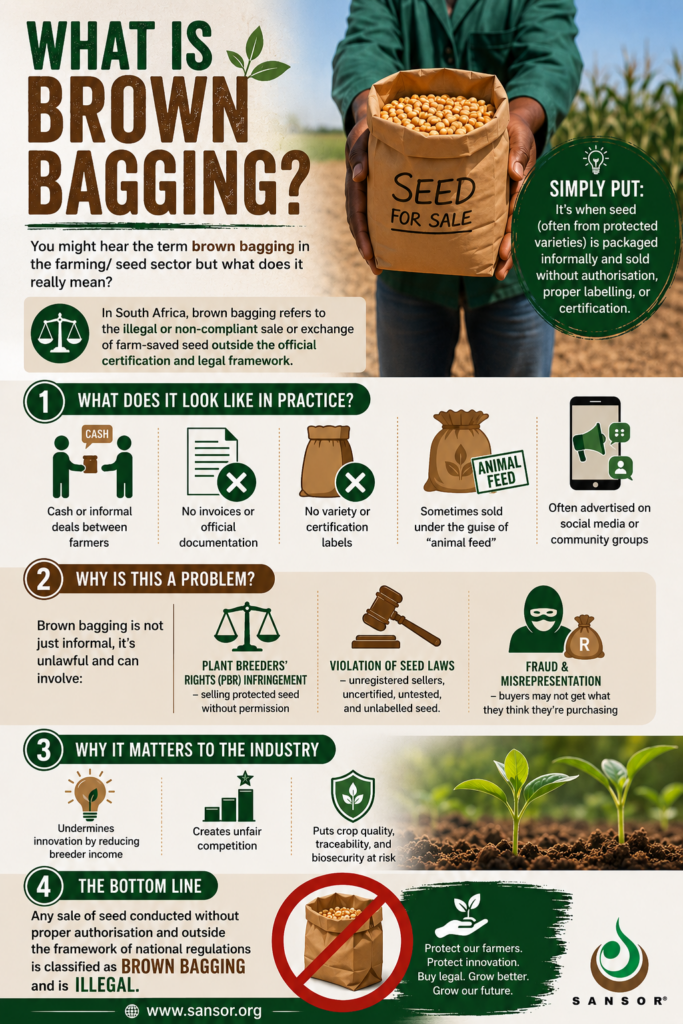
What Is Brown-Bag Seed Bootlegging?
“Brown bagging” is commonly used to describe the informal or unauthorised commercial movement of seed outside approved licensing, certification and regulatory systems.
In practice, this may involve seed that has been multiplied, cleaned, conditioned, treated, packaged, advertised or sold without the necessary permission from the holder of the relevant Plant Breeders’ Rights.
The phrase may sound informal, but the consequences can be serious. Seed is not simply another agricultural input. It carries a genetic identity, quality characteristics, a production history and, where a variety is protected, enforceable intellectual-property rights.
An accountable seed system requires the identity, source and legal status of seed to remain clear throughout the value chain. When seed moves through unknown or unauthorised channels, buyers may not know exactly what they are purchasing, whether it was produced and treated correctly, or whether the label accurately reflects the contents.
The Protected SSH4185 Oats Case
The joint release states that the dispute involved at least 65 tonnes of protected SSH4185 oats propagating material.
The alleged conduct included the unauthorised multiplication of protected material and the unauthorised conditioning, cleaning and treatment of the seed. It also included the marketing and commercial sale of the material outside the authorised distribution chain.
Further concerns included:
- infringement of registered Plant Breeders’ Rights;
- unauthorised use of registered trademarks;
- non-compliance with statutory production and marketing requirements;
- failures involving traceability, record-keeping and labelling;
- off-label use of agrochemicals, potentially transgressing Act 36; and
- conduct potentially attracting civil remedies or criminal sanctions.
These overlapping concerns demonstrate why an accountable response to unlawful seed trade must consider far more than the ownership of one variety. A single commercial transaction can potentially intersect with intellectual-property law, seed regulation, labelling standards, plant-health requirements and unlawful competition.
Why Plant Breeders’ Rights Matter
Improved plant varieties do not appear overnight. They are developed through years of research, selection, evaluation and financial investment.

Dr Lukeshni Chetty, CEO of SANSOR, explained in the release that every improved variety represents years of work and millions of rands in investment before it reaches the market. Plant Breeders’ Rights exist to protect that investment and encourage the continued development of improved genetics that can benefit producers, processors and consumers.
Plant Breeders’ Rights grant breeders defined exclusive rights over protected varieties. Their purpose is not merely to reward one company or organisation. They support a broader system in whichbreeders and seed companies remain willing to invest in the development of future varieties.
An accountable Plant Breeders’ Rights framework therefore helps sustain agricultural innovation while creating rules that farmers, processors, seed conditioners, distributors and rights holders can understand.
Without meaningful protection, the incentive to invest in improved plant genetics can be weakened. Over time, that may affect the development and commercial availability of varieties intended to improve production, quality, resilience or suitability for specific markets.
Potential Remedies Available to the Rights Holder
Syngenta, as the holder of the Plant Breeders’ Rights concerned, potentially had access to several legal remedies.
These could have included an interdict to stop the infringing activity, delivery-up of the protected propagating material, attachment of crops planted with infringing seed, payment of reasonable royalties, damages and legal costs.
At van Rooy, a patent attorney and Plant Breeders’ Rights specialist at KISCH IP, noted that the unauthorised commercial sale and use of protected propagating material is seldom a single-issue dispute.
Plant Breeders’ Rights may intersect with trademark protection, unlawful competition, statutory seed regulation, certification, traceability and broader agricultural compliance. A single instance of unauthorised multiplication may therefore transgress several areas of South African law simultaneously.
Farm-Saved Seed Is Not Subject to a Blanket Ban
The release makes an important distinction: South African law does not impose a blanket prohibition on farm-saved seed.
For generations, farmers have retained seed from one harvest for planting in a following season. The modern legal challenge is to recognise this established practice while protecting the legitimate commercial interests of breeders that invest in improved varieties.
Regulation 5 gives practical effect to the qualified farmer’s privilege recognised in section 10 of the Plant Breeders’ Rights Act 12 of 2018.
Different categories of farmers operate under different circumstances, but commercial seed saving carries corresponding responsibilities.
Where protected propagating material is retained in quantities exceeding prescribed thresholds, Regulation 5(3)(c) requires that the material must have been legitimately obtained.
The breeder or rights holder must be notified of the quantities retained. Reasonable remuneration equivalent to a reasonable royalty must be agreed in a written licence agreement, and the identity of the protected variety must be preserved through appropriate labelling.
This provides an accountable route for lawful commercial conduct instead of treating every instance of retained seed in exactly the same manner.
Transparency, Fair Remuneration and Traceability
The release identifies three principles at the centre of the regulatory framework: transparency, fair remuneration and traceability.
Transparency means that the relevant Plant Breeders’ Rights holder knows what protected material is being retained and in what quantities.
Fair remuneration means that commercial use of the protected material does not simply bypass the investment made by the breeder.
Traceability means that the identity and history of the seed remain clear throughout its movement and use.
Together, these principles provide an accountable basis for balancing the practices of farmers with the legitimate rights attached to protected varieties.
Traceability is especially important because seed can pass through several stages, including breeding, multiplication, conditioning, testing, packaging, distribution and planting. A failure at one point can weaken confidence across the entire chain.
How the Oats Dispute Was Resolved
Although litigation was available, it was ultimately avoided.
Before legal proceedings became necessary, the alleged infringers were invited to regularise their position. The matter was then resolved commercially through the framework established by Regulation 5(3)(c) of the Plant Breeders’ Rights Regulations, 2025.
The settlement included reasonable remuneration for the use of farm-saved propagating material, associated commercial arrangements and a contribution towards legal fees.
This was an accountable resolution because it restored lawful commercial conduct while recognising the legitimate interests of the rights holder.
The outcome also illustrates that firm enforcement and constructive engagement are not necessarily opposites. Rights may be protected while parties are still given an opportunity to achieve compliance where the law allows it.
Who Is SANSOR?
SANSOR is the South African National Seed Organization.
It was established in 1989 to provide participants in the local seed industry with a formal and strategic body that could protect and further the interests of the seed trade. The organisation describes its vision as becoming the foremost authority on seed matters while proactively shaping the seed-trade environment to meet the needs of growing and evolving populations.
SANSOR’s stated purpose is to facilitate the uninterrupted movement of high-quality seed.
The organisation serves the seed industry through certification, engagement on legislation, phytosanitary support, training, industry liaison, market information and assistance with barriers affecting seed trade. It also represents members locally and internationally.
This role places SANSOR at the centre of an accountable national seed environment in which quality standards, legal compliance, plant health and market access must function together.

SANSOR’s Role in Seed Certification
SANSOR is South Africa’s National Designated Authority for seed certification.
Seed certification is a legally sanctioned system for controlling the quality of seed multiplication and production. In simple terms, certification provides assurance that the contents of a seed container correspond with its label and meet accepted standards relating to viability, physical purity, varietal purity and varietal identity.
SANSOR states that certified seed is assessed through more than 90 control or verification points. It maintains the production history of seed lots and verifies the origin of seed through stages ranging from breeder seed to pre-basic, basic and certified seed.
An accountable certification system gives farmers greater confidence that the seed they buy is known, monitored and supported by records.
Certification cannot remove every agricultural production risk. It does, however, provide a far stronger quality and traceability foundation than seed acquired through an unknown or undocumented channel.
SANSOR’s Wider Mission
SANSOR’s work extends beyond seed certification.
The organisation remains active in discussions concerning seed legislation, including the Plant Improvement Act and the Plant Breeders’ Rights Act. It also supports members in understanding and navigating phytosanitary requirements affecting the movement of seed within South Africa and across international borders.
Plant-health requirements are an essential part of seed trade because pests and diseases can disrupt production, market access and cross-border movement.
Training is another important part of SANSOR’s work. The organisation provides courses and workshops for seed-trade personnel, with particular emphasis on seed inspectors and seed samplers.
SANSOR also participates in international industry structures and maintains connections with organisations including the International Seed Federation and the African Seed Trade Association.
This broad mandate helps create an accountable environment in which seed quality, plant health, intellectual property and trade are recognised as interconnected issues.
Why Unauthorised Seed Trade Affects Farmers
Brown-bag seed may initially appear to offer a less expensive alternative. However, the apparent saving can conceal substantial uncertainty.
Farmers may face unanswered questions about varietal identity, germination, purity, treatment, labelling and legal status.
Where seed is marketed outside recognised systems, the buyer may have limited recourse if the product does not perform as expected or is not what it was represented to be.
An accountable purchasing decision involves asking:
- Where did the seed originate?
- Is the seller authorised?
- Is the variety protected?
- Has the seed been certified where applicable?
- Is the variety clearly identified?
- Are invoices and supporting records available?
- Has any treatment been lawfully and correctly applied?
The oats dispute also demonstrates that sellers cannot assume social-media advertising places a transaction beyond regulatory or legal scrutiny. Digital platforms may make informal transactions easier to arrange, but they do not replace authorisation, documentation or statutory compliance.
Why Seed Innovation Supports Food Security
The release connects intellectual-property protection with continued agricultural innovation.
Improved plant varieties can support production, processing and consumer requirements, but their development requires sustained investment.
A seed industry that cannot recover the cost of research and development may become less willing or less able to invest in future breeding programmes.
An accountable innovation system therefore has relevance to food security. It supports the pipeline through which improved genetics may continue reaching farmers.
This does not mean that the interests of farmers and breeders will always align automatically. Farmers require viable production economics, while breeders require protection and fair remuneration. The purpose of the legal framework is to establish a workable balance between those legitimate interests.
What Farmers, Seed Processors and Sellers Should Do
Farmers retaining protected seed should establish whether prescribed thresholds, notification duties or remuneration requirements apply to them. Historical practice should not be assumed to override current legislation.
Seed processors and conditioners should verify that they have authority to handle protected propagating material. Cleaning, grading or treating seed does not remove the intellectual-property rights attached to the variety.
Sellers should confirm that their advertising, labelling, trademark use and distribution arrangements comply with the applicable requirements.
Buyers should be cautious when seed is offered without invoices, certification, traceability, clear varietal information or evidence of the seller’s authority.
An accountable seed transaction is transparent, documented and capable of being verified.
Building Compliance Before Disputes Arise
One of the most valuable lessons from the oats matter is that compliance is easier and generally less disruptive before a dispute begins.
The release notes that seed companies are actively seeking compliance within the agricultural sector with the Plant Breeders’ Rights Act, 2018 and Regulation 5 before disputes arise.
That means communication, notification, licensing and written agreements should happen early.
An accountable commercial relationship clearly establishes who holds the relevant rights, what material is being used, the quantities involved, the remuneration that applies and how the protected variety will be identified.
Where uncertainty exists, farmers and seed businesses should obtain appropriate legal, regulatory or industry guidance rather than relying on assumptions or informal arrangements.
The Wider Lesson for South African Agriculture
The resolution demonstrates that intellectual-property protection does not always require unnecessary conflict.
It requires commitment to the rule of law, responsible stewardship of protected varieties and constructive engagement across the agricultural value chain.
An accountable seed industry protects more than royalty payments. It protects confidence in labels, certification systems, quality assurance, traceability, research investment and the integrity of commercial agriculture.
The oats case sends a clear message: protected seed cannot be multiplied, conditioned and commercially marketed outside the authorised framework without potential consequences.
At the same time, the law provides mechanisms through which certain conduct may be regularised when parties engage transparently, responsibly and within the applicable legal framework.
Frequently Asked Questions About Brown-Bag Seed
1. What is brown-bag seed?
Brown-bag seed generally refers to seed sold or exchanged informally outside authorised licensing, certification or regulatory systems. An accountable buyer should request clear information about the variety, source, seller and documentation.
2. Was the oats dispute only about unpaid royalties?
No. The release identified possible Plant Breeders’ Rights infringement, unauthorised multiplication and conditioning, trademark issues, labelling failures, traceability concerns and wider statutory non-compliance.
3. How much protected oats material was reportedly involved?
Information cited in the release suggested that at least 65 tonnes of the protected SSH4185 propagating material had been multiplied, conditioned and marketed outside the authorised distribution chain.
4. Is all farm-saved seed illegal?
No. The legal framework recognises a qualified farmer’s privilege. However, an accountable farmer must understand any applicable thresholds, notification duties, licensing requirements, remuneration obligations and labelling rules.
5. What does Regulation 5(3)(c) require?
Where the provision applies, the protected material must have been legitimately obtained, the rights holder must be notified, reasonable remuneration must be agreed through a written licence, and the identity of the protected variety must be preserved through appropriate labelling.
6. Why is seed traceability important?
Traceability helps establish the source, identity and production history of seed. It supports quality assurance, regulatory compliance and an accountable response when questions or disputes arise.
7. What is SANSOR’s role?
SANSOR represents and supports the South African seed industry, serves as the National Designated Authority for seed certification, assists with legislative and phytosanitary matters, provides training and supports local and international seed trade.
8. What does certified seed tell a farmer?
Certified seed provides documented assurance that the seed was produced and inspected under an approved system and meets relevant standards for varietal identity, purity and quality. It gives the farmer a more accountable foundation for purchasing decisions.
9. Why was litigation avoided in the oats case?
The parties regularised the matter commercially under Regulation 5(3)(c). The resolution included reasonable remuneration, related commercial arrangements and a contribution towards legal fees.
10. What is the main lesson from the case?
Farmers, processors, sellers and buyers should not treat protected seed as an informal commodity. An accountable approach requires authorisation, documentation, traceability, fair remuneration and respect for the applicable legal framework.
Conclusion
The SSH4185 oats case offers a practical example of how South Africa’s Plant Breeders’ Rights system operates.
It demonstrates the legal and commercial risks associated with unauthorised multiplication, conditioning and marketing. It also shows that a dispute can be regularised commercially without protracted litigation when parties engage constructively and recognise the rights involved.
For farmers, the lesson is to understand the source and protected status of seed they retain, process or purchase.
For seed businesses, the priority is to maintain authorisation, documentation and varietal identity throughout the supply chain.
SANSOR’s work in certification, legislative engagement, phytosanitary support, training and industry representation forms part of this wider system.
Strong seed governance is not merely an administrative requirement. It is part of the foundation on which productive, innovative and sustainable agriculture is built.
Written by M.O taken from the joint media release issued by the South African National Seed Organization, known as SANSOR, and specialist intellectual-property law firm KISCH IP