
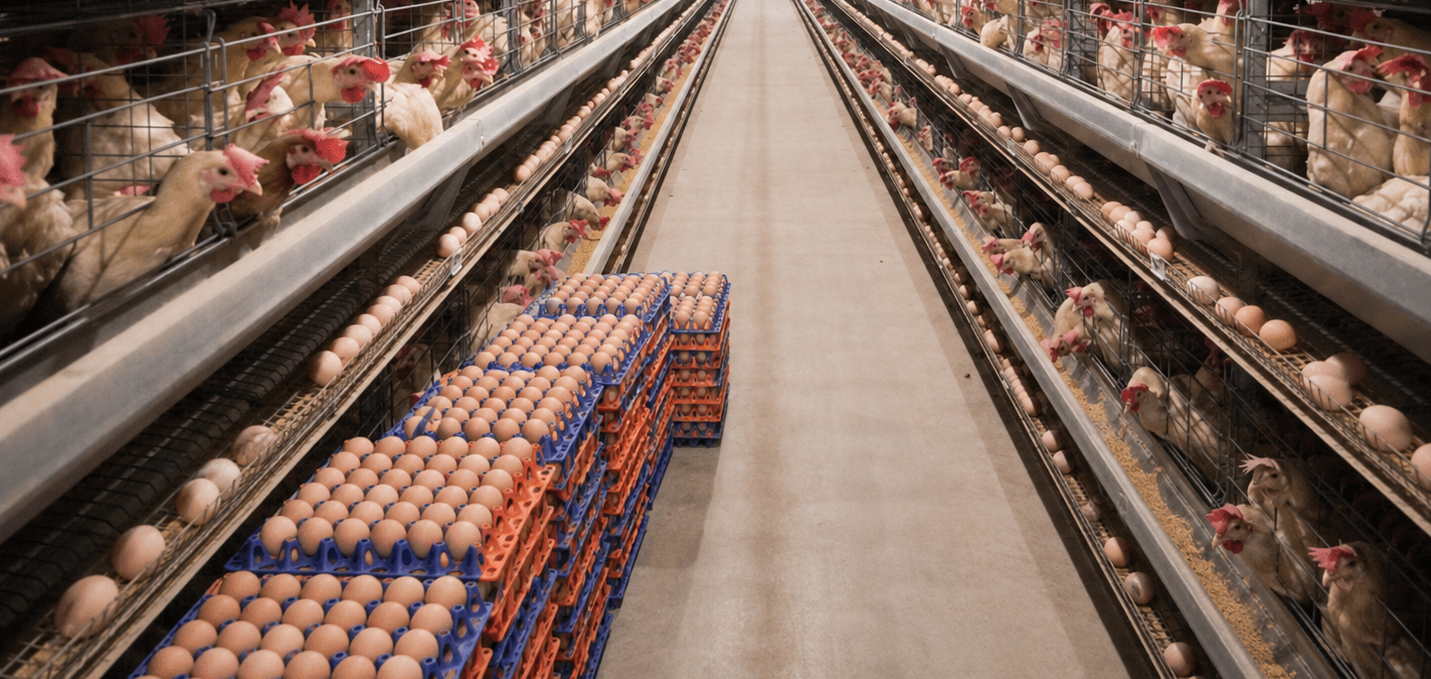
Eggs are one of the quiet heavyweights of South African agriculture. They do not always command the same dramatic attention as red meat politics, grain prices, poultry imports or animal disease outbreaks, yet they sit at the centre of household nutrition, bakeries, restaurants, school meals, hotel kitchens, informal food trade and retail shelves across the country.
They are easy to prepare, relatively affordable, nutritionally dense and deeply familiar to consumers. That is precisely why the egg sector is easy to underestimate. Eggs look ordinary until they are missing. Then their full importance becomes visible very quickly.
That visibility became sharper when South Africa’s layer sector came under biological pressure. The recent shock to egg production reminded the industry that egg farming is not simply a story of hens in a laying house. It is a story of breeder security, pullet supply, hatchery continuity, feed efficiency, disease prevention, housing performance and consumer confidence.
It is also a story of timing. Egg systems do not recover overnight. A disruption today can show up on the shelf weeks or months later. This makes egg production in South Africa a decisive part of the wider food-security conversation.
For many consumers, eggs are not a luxury product. They are a practical food. They are used in breakfast meals, lunchboxes, baking, institutional catering, hospitality kitchens, fast-food products and everyday home cooking. For lower- and middle-income households, eggs often provide one of the most accessible forms of animal protein. Their value is not only in the tray. Their value is in the role they play across the food system.
This is why the egg sector deserves more serious public and commercial attention. It sits inside food security in a way that is both practical and profound. When egg supply is stable, the benefit reaches far beyond the farm gate. When egg supply is disrupted, the pressure is felt in households, bakeries, food service and retail channels almost immediately.

The decisive lesson is simple: egg production is not only about laying hens. It is about the whole chain that supports them.
For broader industry context, producers, suppliers and advertisers can also follow updates from the South African Poultry Association, which represents key interests across South Africa’s poultry and egg sectors.
Readers can also explore more practical agricultural updates and industry features on the Nufarmer Africa website.
South Africa is ordinarily self-sufficient in table eggs
One of the most important points in the South African egg discussion is that the country is normally self-sufficient in table eggs. That sets the egg story apart from the broiler import conversation. Chicken meat imports are a recurring part of the supply balance. Table egg imports are more unusual and tend to reflect particular supply stress rather than the normal state of the market.

This distinction is decisive because it changes how one should read import statistics and sector anxiety. When imports appear in the egg sector, the bigger story may not always be ordinary tray eggs for consumers. It may be fertile eggs for incubation, breeder replacement or efforts to restore pullet supply after disruption.
That means the egg sector’s resilience depends on much more than laying flocks alone. It depends on what is happening upstream in breeder and hatchery systems too.
A commercial layer operation does not begin with a hen already in production. It begins much earlier. Breeding systems, hatcheries, chick quality, pullet rearing, feed planning, disease protection and housing preparation all play a role before the first commercial egg is laid. This makes the egg chain longer, more technical and more vulnerable to delayed disruption than many consumers realise.
That is why egg imports in South Africa must be interpreted carefully. A spike in imports may be a response to consumer demand, but it may also be a sign that the upstream production pipeline has been damaged and needs support. The decisive issue is not simply whether eggs are entering the country. The decisive issue is why they are entering, what part of the chain they are supporting, and whether local production capacity is being rebuilt.
This point is important not only for producers, but also for advertisers and suppliers. The egg story opens far beyond the layer house. It stretches into breeding, incubation, hatchery technology, disease protection, pullet development, housing systems and the timing discipline required to rebuild output after shock.
For companies supplying feed, animal health products, biosecurity systems, water treatment, ventilation, housing, lighting, packaging, hatchery equipment or flock-management tools, the egg sector offers a decisive opportunity. It is an industry that increasingly needs reliable suppliers who understand risk, timing and continuity.
The breeder chain is the hidden engine of egg production
Consumers see eggs on a shelf. Producers see the chain behind that shelf. The breeder chain is one of the least visible but most decisive parts of egg production in South Africa.
Without secure breeder flocks, hatcheries cannot maintain reliable chick supply. Without reliable chick supply, pullet rearing becomes unstable. Without pullets, layer houses cannot be repopulated at the right time. Without correct placement timing, production dips can become more serious and last longer than expected.
This is why breeder security is not a side issue. It is a decisive part of national egg stability.
When disease pressure, mortality, culling or quarantine affects breeder operations, the impact may not be fully visible immediately. The shortage does not always arrive in one dramatic moment. It can move through the system gradually. First, hatchery flow is affected. Then pullet availability becomes tighter. Then layer placements become more difficult. Then production volumes begin to reflect the earlier shock.
This delayed effect is one of the reasons why egg-sector recovery can frustrate consumers and retailers. People expect supply to bounce back quickly. Biology does not work that way. Pullets must be reared. Flocks must come into production. Houses must be cleaned, prepared and stocked. Production must climb gradually.
That makes planning decisive.
A strong egg sector must therefore protect breeder flocks as part of the national food system. This includes disease surveillance, vaccination strategy where appropriate, movement control, strict hygiene, controlled visitor access, rodent control, wild-bird exclusion and careful record keeping.
The industry cannot afford to treat breeder security as a background technical matter. It is a decisive foundation of supply.
Disease changed the way the egg sector thinks about security
Highly pathogenic avian influenza did more than create a temporary shortage. It altered the way the egg sector thinks about recovery, prevention and system strength.
When layer flocks are disrupted, the consequences extend beyond the immediate farm. Pullet replacement becomes a concern. Breeder flocks become more valuable. Hatcheries become more critical. The long rhythm of laying production becomes exposed.
This is why disease pressure has forced the egg sector to become more strategic. The question is no longer simply how to produce eggs efficiently in good times. It is also how to protect the chain in difficult times.
A producer cannot recover lost output instantly after culling or quarantine. Birds must be available. The right genetics must still be in the system. Hatcheries must still function. Feed plans must still align. Retailers must still manage shelves and pricing. Consumers must still understand why the market does not bounce back at the push of a button.
This makes prevention far cheaper than emergency recovery.

It also makes biosecurity a central production tool rather than a side note. Stronger movement control, water hygiene, rodent control, wild-bird exclusion, vaccination discipline, sanitation and training are not optional add-ons in the layer business. They are part of the infrastructure that protects continuity.
In the modern layer sector, biosecurity is now a decisive commercial discipline.
The strongest producers will not be those who only respond well after a crisis. They will be the producers who reduce the risk of crisis in the first place. That means thinking about every entry point into the farm. Vehicles, crates, visitors, feed deliveries, staff movement, equipment, wild birds, rodents, water sources and nearby poultry activity all matter.
The decisive difference between a vulnerable poultry business and a resilient one is often routine. The farm that does the basics every day is better positioned than the farm that only tightens controls when disease is already nearby.
Biosecurity must become a daily habit
Biosecurity is sometimes spoken about as if it is a checklist. In reality, it is a culture. It must become part of the daily rhythm of poultry farming.
A written biosecurity plan means very little if staff do not understand it. Footbaths mean little if they are dirty or ignored. Visitor logs mean little if access is not controlled. Rodent control means little if feed spills are left unmanaged. Water treatment means little if systems are not monitored. Wild-bird exclusion means little if buildings are poorly sealed.
For egg production in South Africa to remain strong, biosecurity must move from paperwork into practice.
This is where training becomes decisive. Workers must know why procedures matter, not only what the procedures are. Farm managers must reinforce standards consistently. Suppliers and service providers must understand access protocols. Veterinarians, consultants and technical representatives must support practical systems that farms can actually maintain.
A decisive biosecurity culture is not built in a boardroom. It is built at gates, sheds, wash stations, feed areas, water lines and staff rooms.
It is also built through investment. Better fencing, controlled access points, dedicated clothing, sanitation systems, water testing, pest control and monitoring technology all cost money. But when compared with the cost of flock loss, production disruption and market instability, those investments can become essential.
The egg sector has learned that prevention may be expensive, but recovery can be far more expensive.
This connects closely with wider animal-health issues covered by Nufarmer Africa, including our article on FMD and livestock disease control in South Africa.
Feed and housing still drive egg profitability
The egg sector’s biological timing is crucial, but it does not replace the fundamentals. Feed remains one of the strongest drivers of profitability in layer farming. Birds need balanced nutrition to maintain egg production, shell quality, flock condition and long-term performance.
Poor feeding decisions can reduce output. Poor environmental control can make even good feed less effective.
That link between feed and housing is decisive.
Layer feed must support sustained production over a long period. It must provide the right balance of energy, protein, amino acids, calcium, phosphorus, vitamins and trace minerals. The goal is not only to produce eggs, but to produce them consistently, efficiently and with strong shell quality.
But feed does not work in isolation. A high-quality ration can be wasted in a poor environment. If birds are under heat stress, they may reduce feed intake. If ventilation is poor, respiratory pressure can affect performance. If water quality is weak, intake and health can suffer. If lighting is inconsistent, production patterns may be affected. If manure management is poor, ammonia can become a serious issue.
This is why housing must be treated as an active part of the layer system.

Temperature, lighting, ventilation, water quality, manure handling and general air quality all influence how birds perform. Producers sometimes focus so heavily on feed formulation that they understate how much the house environment determines whether the ration can do its work.
In hot conditions, birds may reduce feed intake and struggle with shell quality and general output. In damp or poorly ventilated conditions, ammonia and respiratory stress can undermine health and production. Inconsistent water delivery can quietly erode performance. None of this is dramatic when viewed on a single day. Over time, however, it becomes very expensive.
This is where smarter housing, cleaner water systems, more reliable ventilation and stronger environmental discipline become commercial tools rather than technical luxuries.
In the egg sector, comfort is not only about welfare language. It is about maintaining performance. A bird that eats properly, drinks clean water, breathes cleaner air and lives in a more stable environment is better positioned to perform.
That makes housing a decisive profit factor.
Feed efficiency is more than feed price
Feed cost is one of the major pressures in poultry production. It is tempting for producers to focus mainly on the price per tonne. That is understandable, but it can be too narrow.
For related livestock productivity insights, read more on feed efficiency and animal performance in Nufarmer Africa.
The decisive question is not only what feed costs. It is what feed delivers.
A cheaper ration that reduces output, weakens shell quality or shortens flock productivity may be more expensive in practice. A technically stronger ration that supports performance, health and egg quality may deliver better value even if the upfront cost is higher.
Feed efficiency in layer farming must be measured through the whole production result. Egg numbers, egg weight, shell strength, bird condition, mortality, uniformity and flock longevity all matter.
This creates a decisive opportunity for poultry feed companies. The strongest feed businesses are not only selling feed. They are selling technical confidence. They help producers understand formulation, intake, flock phase, mineral balance, shell quality and performance economics.
In a pressured egg industry, feed companies that can support producers with practical advice will stand out. Farmers do not only need a product. They need guidance that helps them protect margin.
That is where the marketing story becomes stronger too. A feed company that can show how it supports layer performance, shell quality, pullet development and long-term flock productivity has a powerful message for the market.
Water quality is often underestimated
Water is sometimes the forgotten input in poultry farming. Feed receives attention because it is expensive and visible. Housing receives attention because it is physical infrastructure. Water often sits quietly in the background.
Yet water quality can be decisive.
Birds drink every day. Water affects feed intake, digestion, health, medication delivery, vaccination processes and general performance. Poor water quality can undermine even strong feed and good housing.
Layer producers should pay close attention to water testing, line cleaning, mineral load, microbial contamination, water pressure and availability. In warm conditions, water access becomes even more critical. If birds reduce intake because water is poor, hot or unreliable, production can suffer.

For suppliers, water systems, treatment solutions and monitoring tools should form part of the egg-sector conversation. The industry needs practical technologies that help farmers manage hidden risks before they become visible losses.
A decisive layer operation is one that treats water as a production input, not just a utility.
Eggs matter because nutrition matters

The egg sector has sometimes undersold itself in the public conversation. Eggs are not merely a breakfast product. They are one of the most practical nutrient-dense foods available to South African households. They offer high-quality protein and valuable nutrients in a format that is familiar, flexible and low-waste.
That nutrition story matters because consumer affordability remains under pressure. Eggs perform an important function in households that need simple, reliable foods that do not require complex preparation. They also matter in institutional catering, school nutrition, hospitality and food-service operations.
Eggs can be boiled, scrambled, fried, baked, added to meals, used in lunchboxes or incorporated into food manufacturing. Their versatility makes them valuable across income groups and food channels.
This gives the industry a stronger narrative than it sometimes uses. Eggs are not only a commodity to be moved by tray count. They are part of the country’s practical nutrition strategy. When egg production is stable, affordable and well supplied, the benefits spread far beyond the farm gate.
In a price-sensitive country, that practicality is decisive
The industry should speak more confidently about this. It does not need exaggerated health claims. It needs clear, honest communication about the role eggs play in everyday nutrition.
A decisive consumer message could strengthen public understanding of why egg production matters.
Imports should be read as a warning signal
Egg imports in South Africa should not be treated as a simple success or failure story. They should be read carefully.
In some circumstances, imports may help ease short-term pressure. They may support supply when local production has been disrupted. They may help stabilise certain parts of the chain while recovery takes place. But imports also point to stress in a sector that is usually able to supply itself.
That is why imports are a decisive warning signal.
They ask important questions. What part of the chain was disrupted? Were breeder flocks affected? Is pullet supply recovering? Are hatcheries functioning strongly? Are disease controls strong enough? Are producers confident enough to reinvest? Is local capacity being rebuilt?
These questions matter more than the import number alone.
A healthy egg industry should not depend on emergency import responses. It should have strong local systems that can reduce the need for crisis measures. That means investing in breeder security, disease prevention, technical training, feed efficiency, housing resilience and better communication across the value chain.
The decisive goal is not simply to stop imports. The decisive goal is to build a local egg sector strong enough that imports remain unusual, limited and temporary.
Rebuilding confidence is the real opportunity
The egg sector now has an opportunity to tell a stronger, more decisive story. It is a story of resilience, timing, breeder recovery, disease discipline and production planning.
It is also a story of innovation and support systems.
The future will belong to businesses that can protect breeder security, maintain pullet flow, preserve flock health and build consumer confidence.
That creates strong relevance for a wide supplier field. Hatchery equipment, animal health, packaging, feed companies, water-system specialists, housing suppliers, ventilation companies, pullet support services and flock-management technology all have a role to play.
Retailers and processors also sit inside the story because shelf stability and confidence are part of the same chain.
If there is one hard lesson from recent disruption, it is this: the egg sector is stronger when it prepares early rather than reacts late. Supply restoration in eggs is never as quick as consumers hope. That makes foresight commercially valuable.
For advertisers and agricultural suppliers, the egg industry is not a narrow niche. It is a technically demanding, food-security-linked market that needs trusted partners. Companies that can help producers reduce risk, improve efficiency and protect output should be visible in the conversation.
This is where agricultural media also plays a decisive role. Farmers need information. Suppliers need a credible platform. The industry needs a place where technical knowledge, commercial solutions and practical farming realities can meet.
The role of suppliers in a stronger egg sector
A stronger egg sector will not be built by producers alone. It will require support from across the value chain.
Feed companies have a decisive role in helping producers improve layer performance, shell quality, pullet development and feed conversion. Animal health companies have a decisive role in disease prevention and flock protection. Housing and ventilation suppliers have a decisive role in environmental control. Water-system companies have a decisive role in intake, hygiene and health. Packaging suppliers have a decisive role in protecting product quality from farm to shelf.
Technology providers also matter. Monitoring systems, flock-management tools, sensors, automated controls and data platforms can help farmers identify problems earlier and make better decisions.
This is the direction in which modern egg production is moving. The industry needs more than products. It needs integrated support.
A decisive supplier is one that understands the producer’s whole problem, not only its own product category.
For example, a feed supplier that understands heat stress, water quality and flock phase can offer better support than one that only sells ration. A housing supplier that understands ventilation, ammonia, stocking density and bird behaviour can offer more value than one that only sells equipment. An animal health company that supports training and prevention can become more than a product provider.
The egg sector will reward suppliers who can think with farmers.
Communication must improve
Another decisive issue is communication. During supply shocks, consumers often see only empty shelves or higher prices. They do not always understand the biological and logistical reality behind those changes.
The industry needs clearer communication about how egg production works, why recovery takes time, why disease control matters and why local production capacity must be protected.
This does not mean making excuses. It means explaining the chain.
When consumers understand that egg supply depends on breeders, hatcheries, pullets, feed, disease control and housing, they are more likely to understand why disruption has delayed consequences. Retailers also need clear communication so they can manage expectations and avoid unnecessary confusion.
Producers need communication too. They need reliable technical information, market insight, disease updates, management guidance and supplier support. The more informed the sector becomes, the better it can respond to pressure.
This is another reason why agricultural publications matter. A credible platform can help carry technical messages to the farmers and agribusinesses that need them.
The decisive future of egg production
South Africa’s egg industry still has strong fundamentals. It is normally self-sufficient in table eggs. It serves a product that remains widely consumed, nutritionally valuable and commercially versatile. It has experienced producers, established supply channels and a product that fits deeply into everyday food use.
Those fundamentals remain decisive strengths.

But the next phase of stability will depend on more than habit and demand. It will depend on stronger breeder security, smarter housing, disciplined disease control, dependable feed performance and clear communication with the market.
These are the decisive building blocks of a stronger egg sector.
The egg producer of the future will not only manage hens. They will manage timing, risk, continuity and confidence. They will understand the chain before the layer house and the market beyond the farm gate. They will treat biosecurity as a daily discipline, feed as a performance tool, housing as an active production system and communication as part of market stability.
That is the more decisive way to understand this sector, and it is the view that will matter most in the years ahead.
Egg production in South Africa has been tested, but the story is not one of weakness alone. It is a story of learning, adaptation and renewed focus. The sector now has the opportunity to rebuild stronger systems, support local supply, protect affordability and remind consumers why eggs matter.
The future will belong to producers and suppliers who understand that resilience is not built after disruption. It is built before it.
That is the decisive lesson for South Africa’s egg industry.
5 Q&A
1. Is South Africa normally self-sufficient in eggs?
Yes. South Africa is ordinarily self-sufficient in table eggs, which makes large egg imports unusual and usually linked to specific supply pressure. When imports become part of the discussion, the industry needs to look at the deeper reasons behind them, including breeder recovery, hatchery capacity, pullet supply and disease pressure.
2. Why did egg imports become a topic during recent disruption?
Egg imports became a topic because the sector needed support after disease pressure affected parts of the production chain. In some cases, import discussions may involve fertile eggs for incubation or breeder and pullet recovery rather than only consumer table eggs. That makes the import story more technical than it may appear from the outside.
3. Why is the egg sector so sensitive to disease shocks?
The egg sector is sensitive because production depends on carefully timed breeder, hatchery, pullet and layer systems. A disruption today can affect supply weeks or months later. Unlike some faster production cycles, egg-sector recovery requires time because new birds must be available, reared and brought into production.
4. What makes housing so important in layer farming?
Housing affects temperature, lighting, ventilation, water quality, manure management and air quality. These factors influence egg output, shell quality, bird health, feed intake and flock performance. Good housing allows feed and genetics to perform properly, while poor housing can quietly reduce productivity and profitability.
5. Why are eggs important beyond the farm gate?
Eggs are a widely used, nutrient-dense and affordable protein source for households, food service, schools, bakeries, hospitality businesses and informal food trade. Stable egg production supports food security, consumer affordability and practical nutrition across South Africa. (M.O)
