
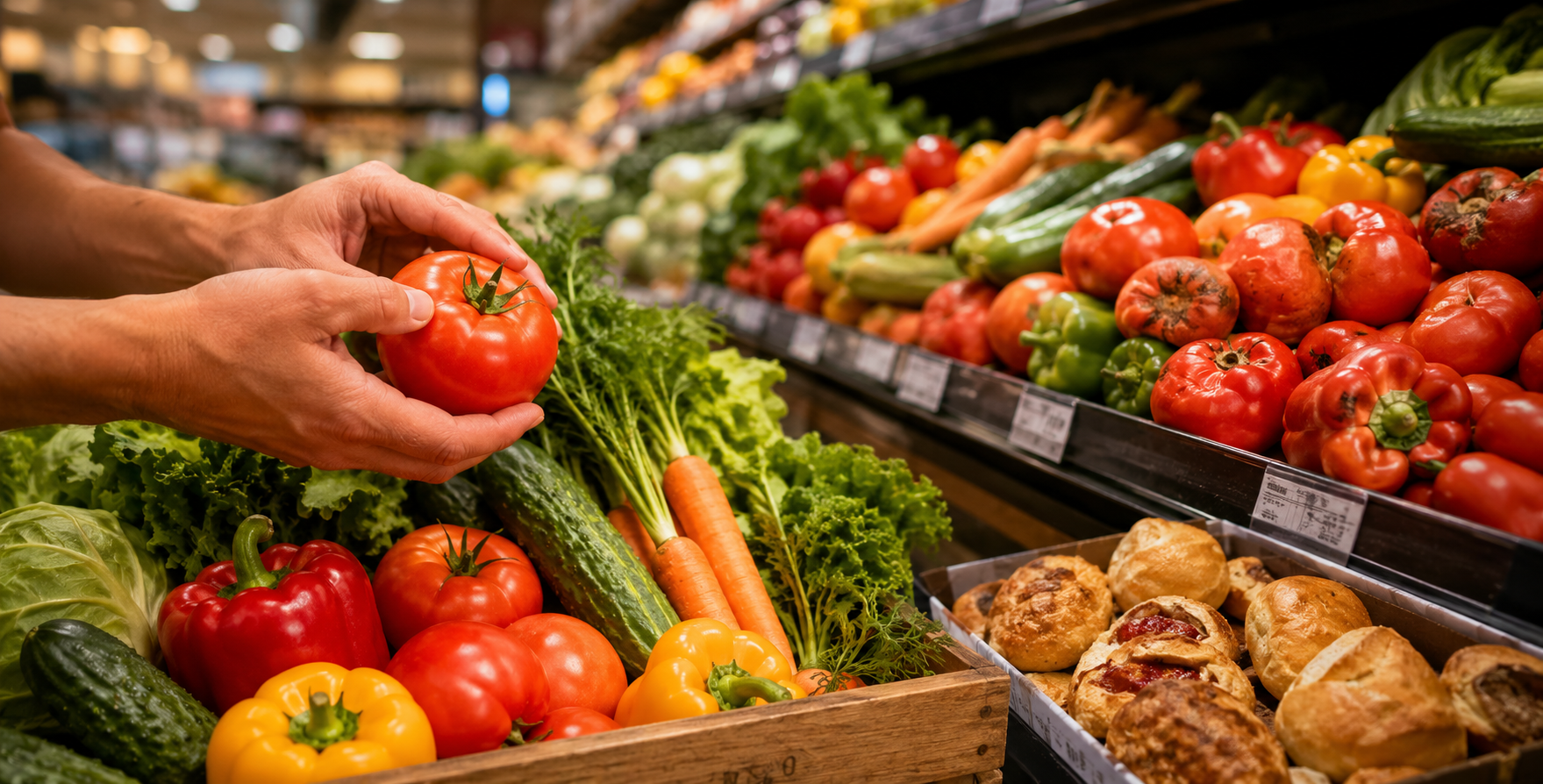
Food waste in South Africa is not only a household problem. It is not only about leftovers scraped into bins, expired groceries forgotten in fridges, or consumers buying more than they need. A major part of the problem begins much earlier and continues through the entire food value chain.
It starts in the field, where food is cultivated with skill, water, fertiliser, labour and risk. It continues in the packhouse, where fresh produce is sorted, graded, cooled and packed. It moves through transport, storage, supermarket receiving areas, display racks, bakery departments and finally into homes or food-service kitchens.
At every stage, value can either be protected or destroyed.
This is what makes food waste in South Africa so urgent. A tomato that is bruised by careless handling at retail level is not just a damaged tomato. It is wasted seed, wasted water, wasted labour, wasted cold-chain effort, wasted packaging and wasted transport. A tray of burnt rolls in a supermarket bakery is not just a baking mistake. It is wasted flour, yeast, electricity, staff time, packaging and profit.
The uncomfortable truth is that food is often treated with care for most of its journey, only to be mishandled at the final stages.
Fresh produce that has been skilfully and lovingly cultivated, scientifically packed and carefully transported can arrive at a supermarket in good condition, only to be squeezed, pushed, dropped, over stacked or forced onto already full racks. In bakery and confectionery departments, repeated baking failures may point to weak technique, poor process control or badly maintained equipment rather than unavoidable waste.
Food waste in South Africa therefore needs to be discussed as a full-chain issue. The urgent question is not only how much food consumers waste. It is how much edible food is being lost because of poor handling, weak systems, avoidable production failures, rigid cosmetic standards and a lack of proper diversion routes before landfill.
Why Food Waste in South Africa Is an Urgent Value-Chain Problem
The Council for Scientific and Industrial Research (CSIR) has estimated that South Africa wastes about 10.3 million tonnes of edible food every year across the agricultural value chain, with around 90% of that waste ending up in landfill. Early production stages account for 68% of losses, with 19% linked to post-harvest handling and storage, and 49% linked to processing and packaging. Fruit and vegetables account for 19% of all food loss and waste by commodity group, while post-harvest waste is estimated to account for more than 44% of all fruit and vegetables produced in the country.
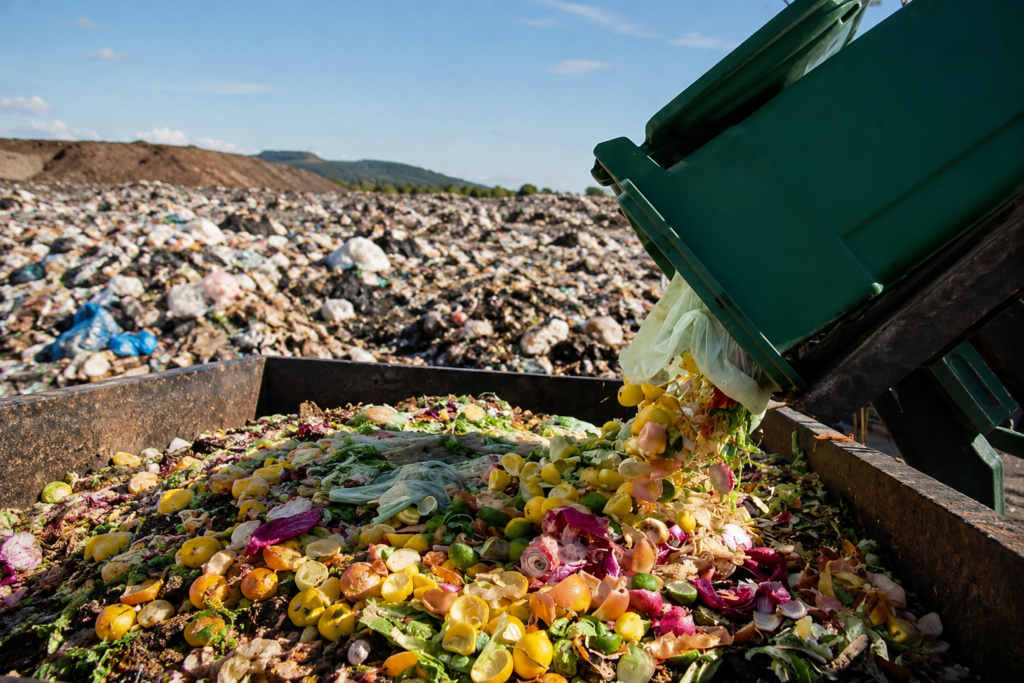
Those figures make food waste in South Africa an urgent agricultural, environmental and economic concern.
For farmers, food waste is not abstract. It is lost income. It is lost pack-out. It is lost return on input costs. For retailers, it is shrinkage, reduced margin and damaged brand credibility. For consumers, it contributes to higher prices and lower availability. For the country, it deepens food insecurity while placing unnecessary pressure on landfills and natural resources.
The United Nations Environment Programme (UNEP), in a report co-authored with the Waste and Resources Action Programme (WRAP), found that 1.05 billion tonnes of food waste were generated globally in 2022. That amounted to 132 kg per person and almost one-fifth of all food available to consumers. Of that total, 60% occurred at household level, 28% in food service and 12% at retail level. UNEP also notes that food loss and waste generate 8–10% of annual global greenhouse gas (GHG) emissions and cost the global economy roughly USD 1 trillion.
The Food and Agriculture Organization of the United Nations (FAO) reports that around 14% of the world’s food is lost after harvest and before reaching retail, while a further 17% is wasted at retail and consumer level. FAO also estimates that the food lost and wasted globally could feed 1.26 billion hungry people every year.
That is why food waste in South Africa must be treated as an urgent system failure, not a minor inconvenience.
Food Loss and Food Waste: Why the Difference Matters
Food loss and food waste are closely connected, but they are not exactly the same.
Food loss usually refers to food that leaves the food chain before reaching retail or consumers. This includes losses during harvesting, handling, storage, transport, processing, grading and packaging. Food waste is often used for food discarded at retail, food service and household level.
This distinction matters because the solutions are different.
If produce is damaged during harvesting, the solution may be better training, better containers and improved handling protocols. If vegetables spoil because a cold room fails, the solution may be temperature monitoring, maintenance or better cold-chain design. If bread is thrown away because too much was baked, the solution may be forecasting and production planning. If edible food is rejected for cosmetic reasons, the solution may be secondary markets, processing, value lines or redistribution.
Food waste in South Africa is urgent because it cuts across all these areas. It is not only a consumer behaviour issue. It is a production, management, infrastructure and market-design issue.
Fresh Produce Is Alive After Harvest
Fresh produce does not become inactive after it is harvested. It continues to respire, lose moisture and respond to temperature, humidity, physical injury and microbial pressure.
This is where careless handling becomes so damaging.
FAO explains that physical injury from careless handling causes internal bruising, splitting and skin breaks. These injuries increase water loss, speed up physiological breakdown and create entry points for decay organisms.
This principle applies from farm to shelf. If rough handling is unacceptable in the field, it should also be unacceptable in the supermarket.
A tomato does not become tougher because it has reached a retail display. A pepper does not become immune to bruising because it is under bright store lighting. Leafy vegetables do not stop losing moisture because they are arranged neatly on a rack. Fresh produce remains perishable, delicate and biologically active until it is consumed.
That makes retail handling an urgent part of food-waste reduction.
When the Supermarket Shelf Becomes a Waste Point
At supermarket level, fresh produce often reaches the final stage of its journey in excellent condition. It has been grown, harvested, packed, cooled and transported with care. Then the last few metres of handling can undo the whole chain.
This is visible in many fresh-produce departments. Rack packers may throw produce onto shelves, push new stock into already packed displays, squeeze soft items to make space, overfill racks, stack heavy produce on delicate produce, or rotate stock poorly. Sometimes the goal seems to be a full-looking display rather than a protected product.
The result is avoidable waste.
A full display may look attractive to the customer, but if produce is crushed at the bottom, bruised during replenishment or pushed into poor airflow conditions, the display is not efficient. It is waste waiting to happen.
FAO identifies mechanical damage and overheating as major causes of loss during transport, including careless handling during loading and unloading, poor stowage, packages stacked too high, ventilation problems and exposure to sun. Although this guidance is focused on transport, the same logic applies to retail handling. Poor stacking, poor airflow and careless movement damage food wherever they occur.
Retailers should therefore treat shelf-packing as a food-preservation function, not only a merchandising task.
This is an urgent training gap. Staff working in fresh produce should understand that every push, squeeze, drop and over stack has consequences. The person packing the shelf is part of the post-harvest chain.
Retail Display Must Protect Food, Not Just Sell It
Retailers understandably want abundant, attractive displays. Customers often associate full shelves with freshness. But abundance can become destructive when display design ignores product biology.
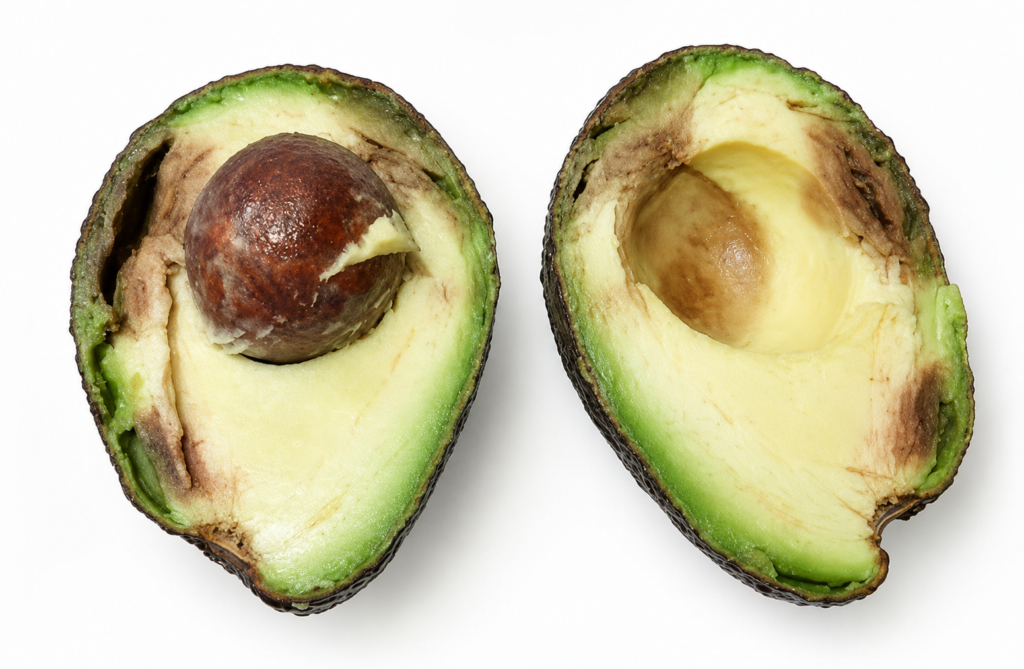
Loose tomatoes piled too high can bruise. Peppers forced into tight spaces can crack or soften. Leafy greens exposed to poor humidity can wilt. Avocados handled repeatedly can develop internal damage. Punnets overstacked under pressure can collapse. Older stock hidden beneath new stock can decay before it is sold.
This makes food waste in South Africa an urgent retail-management issue.
Fresh-produce managers should measure waste by display type, product, shift and cause. They should ask:
Which products are most often damaged during shelf packing?
Which displays create the most shrinkage?
Which staff shifts produce the highest waste?
Is stock rotation happening properly?
Are shelves being filled for visual effect at the expense of shelf life?
Is fresh produce being handled like living food or like dry groceries?
The answers matter. Retail shrinkage is not always caused by customer handling or poor supply. Sometimes it is caused inside the store.
Bakery and Confectionery Waste: A Sign of Weak Process Control
The bakery and confectionery department is another urgent waste point.
In-store bakeries create fresh food daily, but they also create visible waste: burnt loaves, collapsed cakes, overbaked muffins, dry rolls, broken pastries, poor icing work, incorrectly proofed dough, stale products and unsold batches.
Some waste is unavoidable in any fresh-food production environment. But repeated baking failures are not normal. They usually point to one of several causes: poor staff training, incorrect technique, weak supervision, inconsistent recipes, inaccurate weighing, poor oven calibration, unsuitable proofing conditions, bad production planning or poorly maintained equipment.
Feedipedia describes bakery waste as including products from the bakery and viennoiserie industry such as croissants, sweet breads, cakes, dough, tarts and pies. It also notes that bakery waste can include stale bread, dough, flour, sugar, icing, burnt products and broken products.
This matters because bakery waste is not always simply “unsold food.” It can be the visible evidence of operational failure.
Feedipedia further notes that bakery waste can result from inappropriate lot sizes, inappropriate production batch sizes, wasted dough and low-quality products with poor size, texture or burning. It also records that bakery waste occurs at every stage of production and cites a Norway estimate where around 14% of fresh bakery goods produced were wasted at production stage.
That global context shows that bakery waste is not a South African issue only. It is a worldwide manufacturing and retail problem. But in South Africa, where electricity costs, ingredient costs and food insecurity are all serious pressures, preventable bakery waste deserves urgent attention.
Bakery Waste Should Be Prevented Before It Is Redirected
Bakery waste can sometimes be redirected into animal feed, fermentation, biopolymer production or other uses, provided it is safe and properly managed. Feedipedia notes that bakery waste is widely used as feed for farm animals, helping reduce disposal and environmental pressure.
However, redirection must not become an excuse for poor bakery practice.
The first goal must be prevention. A bakery department should know exactly how much waste comes from production failures, unsold goods, stale stock, damaged display items, trimming waste and forecasting errors.
Each category requires a different solution.
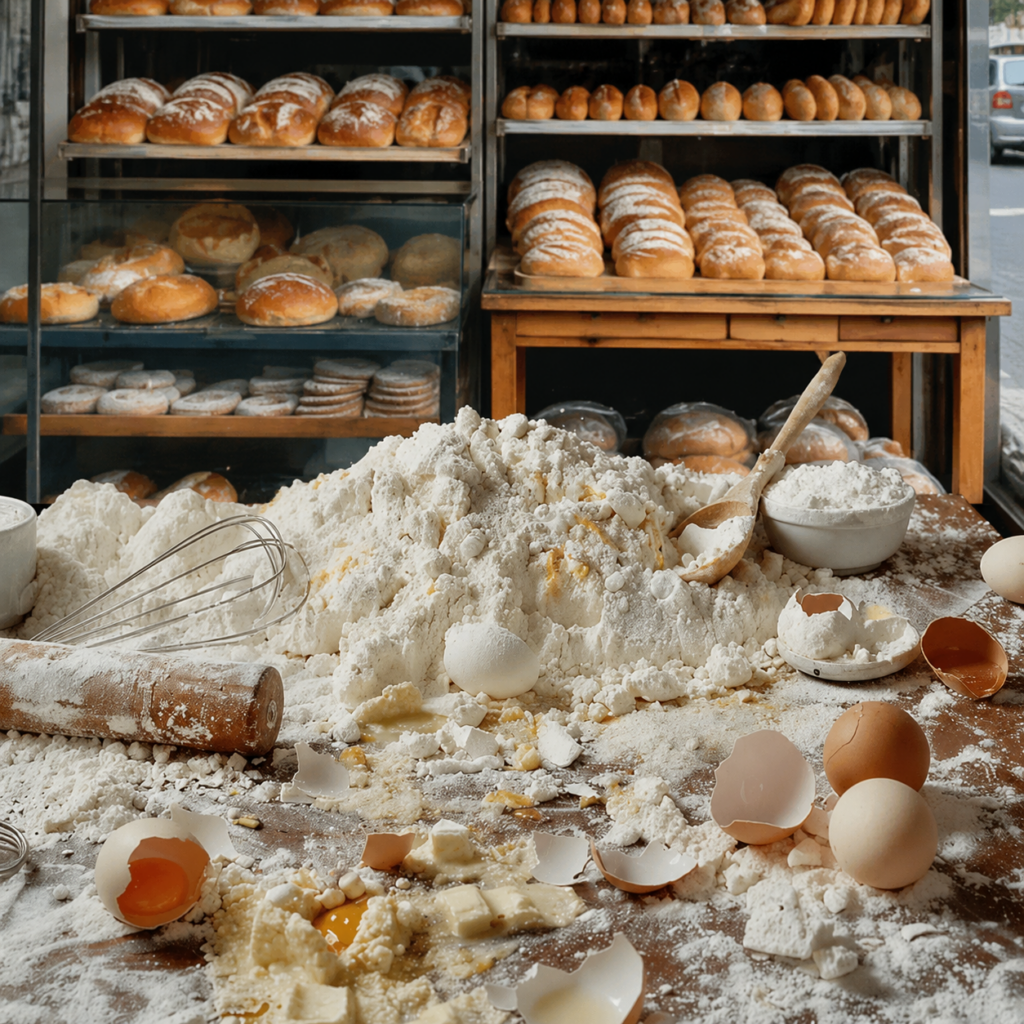
Production failures require technical correction. Unsold goods require better demand forecasting, smaller batches or timed markdowns. Stale stock requires improved rotation and production planning. Damaged display items require better handling. Equipment-related failures require maintenance and calibration.
A bakery manager should be able to answer an urgent question every day: what was wasted, why was it wasted and what will change tomorrow?
Cosmetic Standards and the Rejection of Edible Food
Food waste in South Africa is also driven by appearance.
Fresh produce can be safe, nutritious and edible, yet rejected because it is too small, too large, slightly misshapen, uneven in colour or cosmetically imperfect. Formal markets need standards, but not every cosmetic rejection is justified from a food-security or environmental point of view.
A slightly bent carrot is still food. A small pepper is still food. A scuffed butternut is still food. A loaf with a slightly uneven shape may still be food. A muffin that is safe but not perfectly domed may still be food.
The urgent issue is not whether standards should exist. They should. The issue is whether edible products outside premium specifications have a planned route.
That route may be a value range, processing channel, prepared-food department, soup kitchen, food redistribution programme, animal feed pathway or composting system. What should not happen is edible food being treated as worthless simply because it does not match a narrow idea of perfection.
A food system that only rewards visual perfection will keep wasting edible food.
Cold Chain Is Still an Urgent Weak Link
Fresh food depends on temperature control. For vegetables, fruit, dairy, meat, prepared foods and bakery items with short shelf lives, time and temperature determine quality.
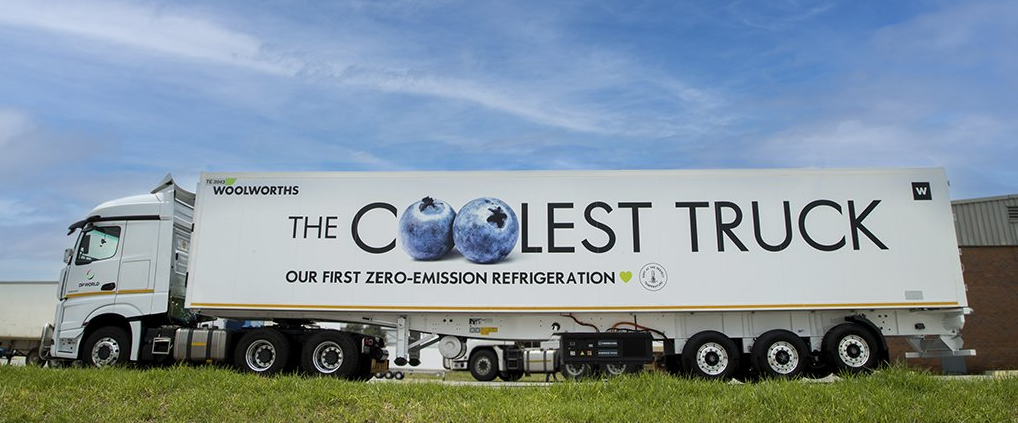
Inadequate cold-chain infrastructure remains one of the most urgent causes of food loss. Fresh vegetables require temperature management from harvest to market, and insufficient refrigeration contributes to significant global food loss.
At farm level, the cold chain may begin with shade, rapid collection and cooling. At packhouse level, it may involve cold rooms, forced-air cooling, humidity management and temperature records. During transport, it may require ventilated or refrigerated vehicles. At retail level, it involves receiving procedures, back-of-store storage, shelf temperature, stock rotation and display management.
The cold chain does not end when a truck arrives at the supermarket. It ends when the product reaches the consumer in good condition.
That is why retail receiving areas, back rooms and shelves need the same discipline as packhouses. A product can survive the journey from farm to store and still be wasted because it sat too long in a warm receiving area or was displayed incorrectly.
Measure First, Then Manage
One of the most urgent actions in food-waste reduction is measurement.
Without measurement, waste becomes a vague operating cost. With measurement, it becomes a management problem.
World Wide Fund for Nature South Africa (WWF South Africa) research has indicated that less than 40% of South African farmers track how much produce is wasted on-farm. A basic waste audit by crop, stage and cause is therefore a practical starting point.
The same principle applies to retailers and bakeries.
A supermarket should not only know its total shrinkage value. It should know whether fresh produce is being wasted because of expiry, bruising, overstocking, poor rotation, temperature failure, poor shelf packing or customer damage.
A bakery should not only record unsold goods. It should separate production failures, overproduction, staling, broken items, recipe errors, equipment failures and display damage.
Measurement is urgent because it turns assumptions into evidence. Once a business knows where waste happens, it can act.
Practical Steps for Farmers, Retailers and Bakeries
Food waste in South Africa can be reduced through practical, disciplined steps.
For farms and packhouses, the urgent priorities include better harvest timing, careful handling, clean and suitable containers, shade at collection points, quick movement into cooling, clear grading systems, trained workers and proper records of rejected or low-grade produce.
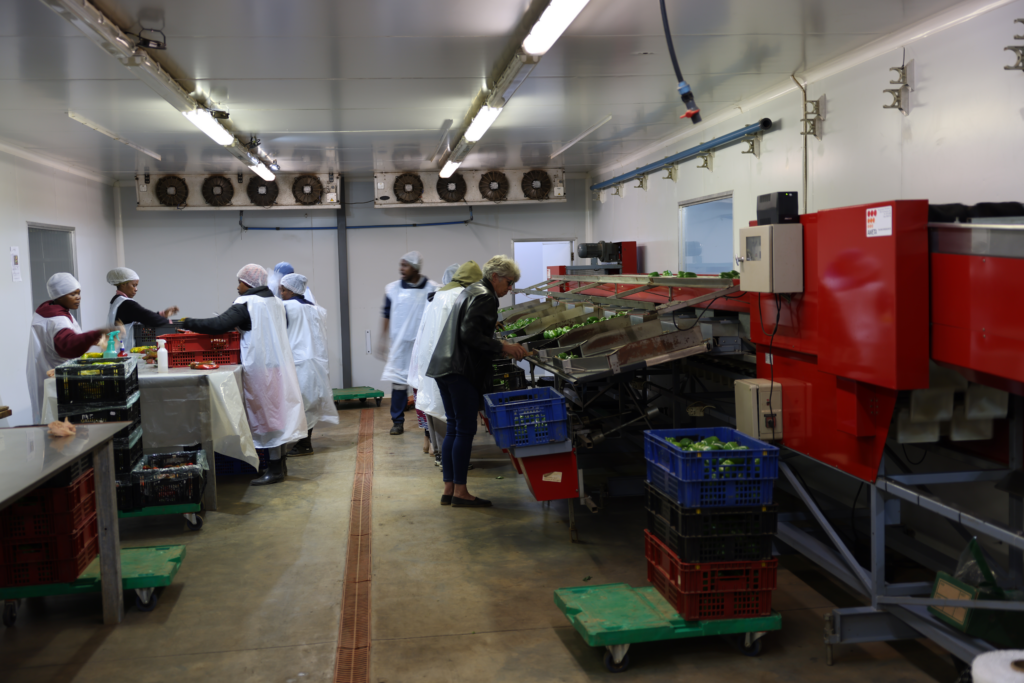
FAO states that packing houses should assemble, sort, select and package produce in an orderly manner with minimum delay and waste. It also notes that packed boxes should be handled carefully to avoid damage, protected from sun and rain, stacked for ventilation and moved quickly to market.
For supermarkets, urgent action includes training fresh-produce staff, reducing overstacking, improving rotation, measuring waste by display type, monitoring temperature, avoiding excessive handling and treating shelf-packing as part of the cold chain.
For bakeries, urgent action includes standard recipes, calibrated ovens, proper proofing control, preventive maintenance, staff training, smaller batches, better forecasting, timed markdowns and separate waste tracking by cause.
For transporters, urgent action includes careful loading, suitable vehicles, ventilation, route planning, shaded waiting areas and reducing delays during unloading.
For every stage, the principle is the same: protect the food that has already been produced.
Divert Before Discarding
When food cannot be sold through its intended channel, it should not automatically go to landfill.
South Africa’s food-waste hierarchy is clear: edible food should first be redistributed for human consumption. If it is unsuitable for people, it can be used as animal feed. If that is not possible, composting or bioconversion should be considered. Landfill should be the last resort. Food redistribution organisations such as FoodForward South Africa (FoodForward SA) can help connect edible surplus with people who need it.
This requires planning. Donation cannot begin only when produce is already spoiled. Retailers, packhouses and farms need approved partners, collection schedules, food-safety rules and clear responsibility.
The urgent mindset shift is simple: surplus food is not automatically waste. Often, it is food without a route.
Composting and Circular Use Still Matter
Not all food can be saved for human consumption. Some waste is unavoidable: trimmings, spoiled items, damaged leaves, unsafe products and inedible residues.
But even then, landfill should not be the first option.
Composting vegetable waste on-farm keeps organic material out of landfill, reduces methane-generating disposal and returns nutrients to soil.
For bakeries, safe surplus may have feed or industrial uses, but mouldy, contaminated or unsafe material must be handled responsibly. The urgent point is to separate edible surplus, feed-suitable surplus, compostable material and true waste. Mixing everything into one waste stream destroys value.
A circular food system depends on sorting, planning and discipline.
The Bigger Policy and Market Picture
The Department of Forestry, Fisheries and the Environment (DFFE), through South Africa’s National Waste Management Strategy 2020, set targets that include a 50% reduction in food waste by 2030 and a 45% reduction in landfill-bound waste by 2025. As buyers increasingly ask for verified sustainability credentials and carbon-footprint reporting becomes more standard in export markets, measurable waste reduction can become a commercial advantage.
This connects directly with Sustainable Development Goal (SDG) 12.3, which aims to halve per-capita global food waste at retail and consumer level and reduce food losses along production and supply chains, including post-harvest losses.
For South African farmers, retailers, processors and food manufacturers, this is an urgent business signal. Waste reduction is no longer only a moral or environmental issue. It is becoming part of market access, buyer confidence and operational performance.
Businesses that can prove waste reduction will be better positioned than those that cannot.
Respect Is the Missing Ingredient
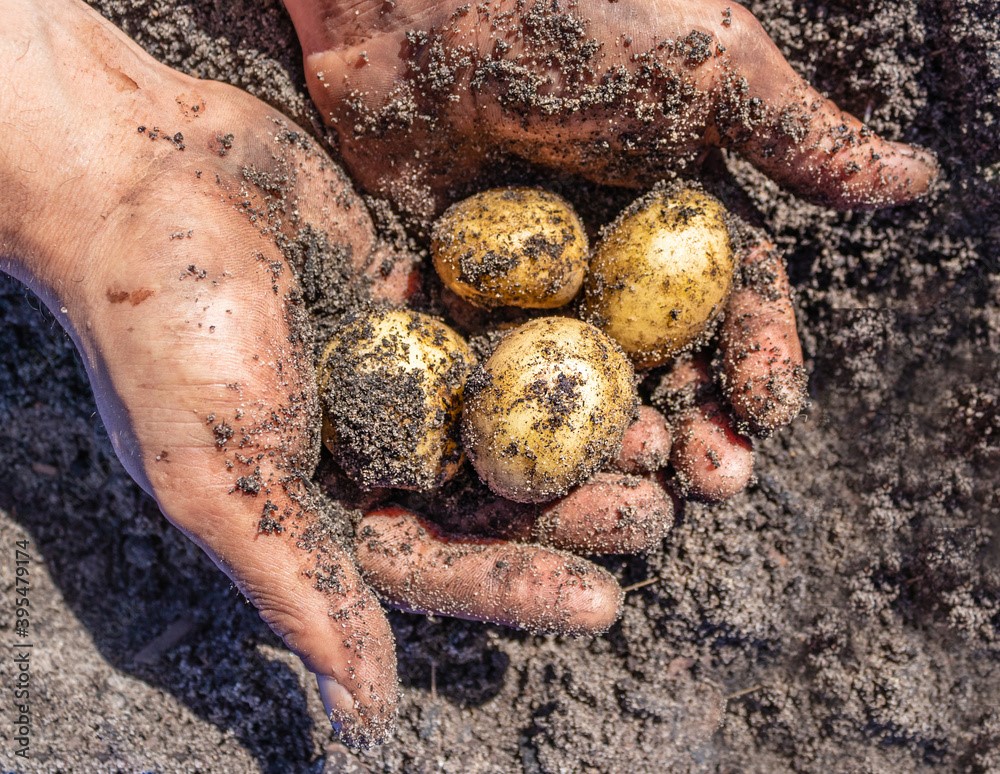
At the centre of food waste in South Africa is a lack of respect.
Respect for the farmer who grew the crop. Respect for the worker who harvested it. Respect for the water used to produce it. Respect for the packhouse that prepared it. Respect for the transporter who moved it. Respect for the consumer who pays for it. Respect for the hungry person who never receives it. Respect for the environment that absorbs the cost when food is dumped.
That respect must show up in practical actions.
It must show up when a rack packer handles tomatoes. It must show up when bakery staff weigh ingredients. It must show up when an oven is maintained. It must show up when a retailer decides not to overfill a display. It must show up when a packhouse records low-grade produce instead of ignoring it. It must show up when edible surplus is redirected early enough to still feed people.
Food waste in South Africa is urgent because the country cannot afford to waste food, water, energy, labour or opportunity.
The country does not only need to produce more food. It needs to waste less of the food already produced.
Every kilogram saved from the bin is value protected. Every cold room that works properly helps food reach the consumer it was grown for. Every supermarket that handles produce carefully protects the work of the farmer. Every bakery that reduces avoidable failures protects ingredients, electricity, labour and profit.
The loop can be closed. But it starts with treating food as valuable at every stage.
Frequently Asked Questions
1. Why is food waste in South Africa an urgent issue?
Food waste in South Africa is urgent because it affects food security, farm profitability, landfill pressure, water use and climate impact. Large volumes of edible food are lost before they reach consumers, while many households still struggle with access to nutritious food.
2. What causes urgent fresh-produce waste at supermarket level?
Urgent fresh-produce waste often comes from rough shelf packing, overstacking, poor stock rotation, temperature breaks and excessive handling. Produce can be grown and transported carefully, then damaged in-store through poor rack-packing habits.
3. Why is bakery waste an urgent retail concern?
Bakery waste is urgent because repeated failures such as burnt products, collapsed cakes, wasted dough and unsold overproduction often point to weak forecasting, poor technique, poor supervision or badly maintained equipment.
4. How can farmers respond to urgent post-harvest loss?
Farmers can respond to urgent post-harvest loss by measuring waste by crop and cause, improving harvest handling, using suitable containers, protecting produce from heat, strengthening cold storage and planning secondary outlets for lower-grade produce.
5. How can supermarkets reduce urgent food waste?
Supermarkets can reduce urgent food waste by training staff, improving shelf-packing practices, avoiding overfilled displays, monitoring refrigeration, rotating stock properly, recording waste by cause and redirecting edible surplus before it spoils.
6. Why are cosmetic standards an urgent food-waste problem?
Cosmetic standards become an urgent problem when edible, safe and nutritious food is rejected only because of size, shape or appearance. Imperfect produce needs alternative routes such as value lines, processing, donation or animal feed.
7. What is the urgent role of food redistribution?
The urgent role of food redistribution is to move edible surplus to people before it becomes waste. Farms, packhouses, retailers and bakeries should have pre-arranged partners and protocols so edible food is redirected early.
8. What is the most urgent first step in reducing food waste?
The most urgent first step is measurement. Businesses must know what is wasted, where it is wasted and why. Once food waste is measured by cause, practical reduction becomes much easier.
(M.O)