
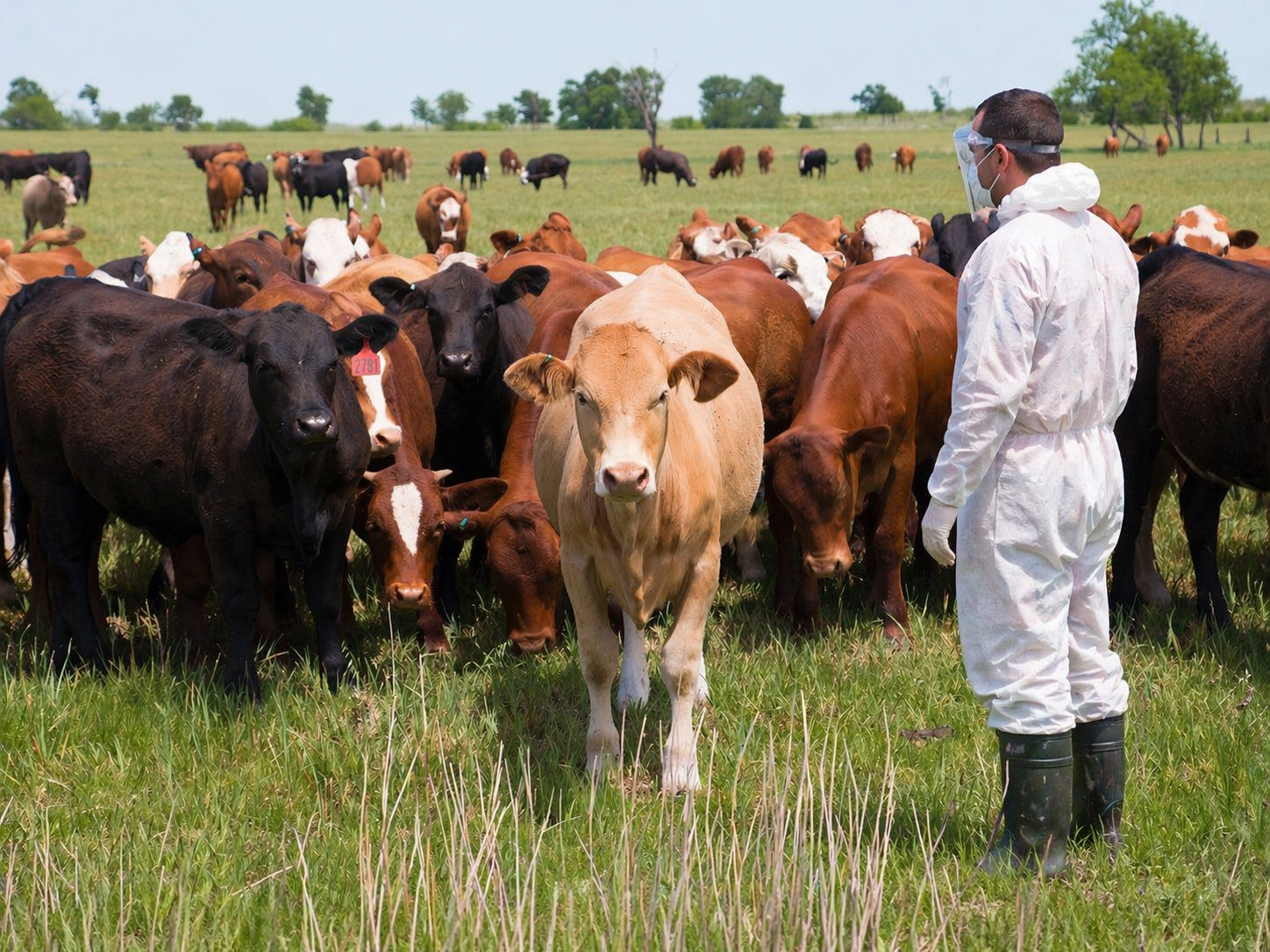
South Africa’s vital response to foot-and-mouth disease has shifted from crisis mode to something bigger, more structured and far more consequential. Vaccines are arriving, local production is back, field strains have gone to Pirbright for specialist testing, and government is moving toward a formal vaccination framework. But on farms, in feedlots and across livestock markets, the real question remains unchanged: can the country turn momentum into control before more damage is done?
A disease that reaches far beyond the kraal
Foot-and-mouth disease is often discussed as though it belongs only to veterinarians, laboratories and emergency briefings. But anyone working in livestock knows better. FMD reaches far beyond infected animals. It affects movement permits, auction confidence, feedlot planning, dairy operations, market stability and cash flow. Even where animals recover, the disruption can linger. ARC Onderstepoort Veterinary Research has been clear on this point: the disease spreads rapidly at herd level and causes severe economic disruption through restrictions and trade effects, not only through clinical illness itself. That is what makes the current response so vital to South Africa’s livestock economy.
This is why the conversation in 2026 feels different. South Africa is no longer treating FMD as a passing veterinary flare-up that can be pushed back into the shadows with a few emergency statements. It is now being handled as a national livestock challenge with long-term implications for agricultural confidence, producer trust and future trade credibility. That is an important shift, and it is one of the more vital developments in the story.
A more serious strategy has taken shape
The clearest sign of that change came in January, when Agriculture Minister John Steenhuisen announced that South Africa had resumed sending FMD field strains to the Pirbright Institute in the United Kingdom for the first time since 2011. That may sound technical, but it is one of the most vital parts of the whole response. Pirbright is the world reference laboratory for foot-and-mouth disease, and its task is to determine whether the vaccines available to South Africa are a suitable antigenic match for the strains currently circulating in the field. In plain terms, it helps answer one of the biggest questions in any vaccination campaign: are we using the right vaccine against the right threat?
That same January announcement also outlined a 10-year eradication strategy aimed at moving South Africa toward FMD-free status with vaccination. In the immediate term, the plan focuses on stabilisation through mass vaccination in high-risk areas. Government said it wants at least 80% coverage in targeted cattle populations and up to 100% coverage in feedlots and dairy cattle, while also reducing outbreak levels significantly in the most affected provinces. Those targets matter because WOAH’s own guidance says vaccination campaigns must move quickly, reach high enough coverage and use strains that match the viruses on the ground. That makes scientific accuracy and field speed equally vital.
The vaccine campaign has gained real momentum
For farmers who were frustrated by slow or uncertain responses earlier in the year, the vaccine programme has at least begun to show movement at scale. In January, the Department said Biogénesis Bagó would deliver one million doses by mid-February and a further five million by mid-March, while Turkey’s Dollvet and the Botswana Vaccine Institute were also expected to contribute supply. On 23 March, the Department confirmed that SAHPRA had expedited the importation of six million Dollvet doses, and it also said a further five million Biogénesis Bagó doses would be ordered. That is not small change. It marks a serious acceleration in response capacity.
Cabinet’s own wording showed just how large the task has become. In its 25 February statement, Cabinet said the national mass vaccination programme is aimed at around 14 million cattle and may require roughly 28 million vaccine doses over 12 months. It also said central procurement was necessary to ensure the correct vaccine was sourced for the circulating strain. That detail is vital because it tells us something about the state’s mindset. This is not being approached simply as a supply problem. It is being approached as a coordinated disease-control programme where vaccine choice, pace and oversight all matter.
By mid-April, the rollout had moved well beyond the planning stage. Government reported that more than 1.7 million animals had been vaccinated by 26 March, and that another 3.5 million doses were expected during April. The same progress update noted that outbreaks had been detected across all nine provinces, which only sharpened the urgency. South Africa is no longer dealing with a neatly contained regional problem. The response now has to function as a national one, and that makes coordination more vital than ever.
Local production is back, but the story needs balance
One of the more encouraging developments has been the return of local production. Government has said the ARC and OBP production line would initially produce around 20,000 doses per week, with further scale planned. That matters strategically. A country facing recurring FMD pressure cannot stay entirely reliant on offshore supply whenever outbreaks intensify. Local vaccine capacity is a vital piece of resilience, even if imported doses remain necessary in the near term.
But this is also where the story needs care. ARC has made an effort to correct some of the more dramatic assumptions that took hold in public debate. In February, it explained that FMD vaccine development is a long and cumulative scientific process involving candidate strain identification, adaptation, long-term trials and regulatory milestones. ARC said it is inaccurate to suggest that because a vaccine was registered in 2022, a massive ready-to-use national stockpile should already have existed. It also said it is wrong to present the current vaccine as though it appeared suddenly out of nowhere. Progress has been real, but it has been built over time. That scientific honesty is vital, especially in a crisis where mistrust can spread almost as quickly as the disease itself.
The same caution applies to the local weekly production figure. Official material shows that government expected ARC to reach around 20,000 doses a week from March, and on 1 April the Department and ARC reported the release of an additional 20,000 locally produced doses. That indicates the milestone was reached. What has not yet been clearly confirmed in official week-by-week reporting is whether that output is now being sustained continuously every single week. So the honest position is that South Africa has reached the 20,000-dose mark, but public official reporting has not yet fully demonstrated a stable weekly rhythm at that level.
The so-called privatisation debate is really about control
One of the most misunderstood parts of the current FMD story is the argument over “privatisation.” The term sounds dramatic, but it does not accurately describe what is really at stake. The debate is less about selling off the animal health system and more about decentralisation. In other words, should private farmers and veterinarians be allowed to play a greater role in procuring and administering vaccine, or should the process remain tightly controlled through the state-led system? That distinction is vital because it changes the whole tone of the debate. This is not a battle between public good and private greed. It is a battle over speed, capacity, oversight and trust.
The Pretoria High Court matter in March became a turning point, but not in the way some of the louder claims suggested. On 24 March 2026, the Gauteng Division of the High Court did not grant urgent relief for unregulated or unsupervised private vaccination. According to the Minister’s official statement, the court affirmed the Department’s lawful authority to regulate the national FMD response, refused the urgent interim relief being sought, and postponed the matter to allow time for the Department to finalise its vaccination scheme. That is an important correction, because some commentary framed the outcome as though private actors had suddenly been cleared to vaccinate freely. They had not. The court kept the Department’s authority intact while pushing government to move faster on a formal framework.
A hybrid model now seems to be emerging
What the Department has signalled since then is not a full retreat and not a hard-line monopoly either. Minister Steenhuisen said the forthcoming scheme would create “a structured mechanism for broader participation” while maintaining safeguards around traceability, vaccine integrity and disease control. That language points clearly toward a hybrid model. The private sector may well be given a broader role, but within a formal regulatory structure rather than outside it. For a country trying to manage disease while rebuilding confidence, that middle path may prove vital.
On 10 April, the Minister announced the planned publication of the Routine Vaccination Scheme for Foot and Mouth Disease under the Animal Diseases Act, with public comments invited before finalisation. That is a significant development because it suggests that FMD vaccination is being moved out of the realm of emergency improvisation and into a more regularised policy framework. That matters. A country can respond to one outbreak with urgency. It can only manage repeated pressure with systems. In that sense, the Routine Vaccination Scheme could become one of the most vital legacies of this difficult period.
Vaccines alone will not settle this
The danger in focusing too heavily on dose numbers and court developments is that the broader disease-control picture gets lost. WOAH is very clear: vaccination must be integrated with surveillance, tracing, quarantine, movement control, disinfection, monitoring and reporting. A successful FMD response is not a pile of vaccine in a warehouse. It is a functioning system that knows where the disease is, where animals are moving, how exposure is being managed and whether the right strain is being used in the right place. That systems view is vital if South Africa wants more than temporary relief.
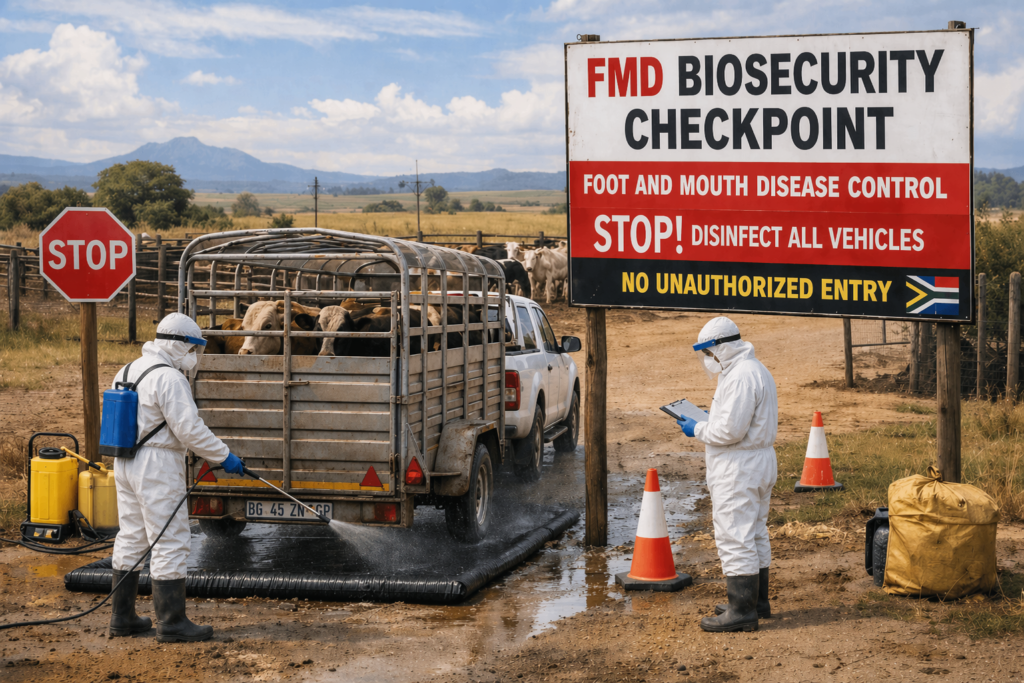
This is where execution becomes the real frontline. It is one thing to announce doses. It is another to get them to the right cattle populations at the right pace with the right records and the right follow-through. It is one thing to speak about broader participation. It is another to design a scheme that is fast enough for farmers, credible enough for regulators and traceable enough for future status recovery. Those are not side issues. They are the heart of the matter.
Credibility is now as important as containment
South Africa is fighting two battles at once. The first is the visible one: controlling outbreaks on farms and in the field. The second is quieter but just as vital: restoring faith in the national response. That includes producers who need clarity, markets that need confidence and international systems that require evidence-based compliance. WOAH’s framework for recognised disease status makes it clear that trust is built on documented, science-based control measures, not on optimistic messaging.
That is why this moment feels so important. The ingredients of a better response are finally on the table. South Africa has resumed international strain testing through Pirbright. It has expanded imported supply. It has revived local production. It has vaccinated more than 1.7 million animals. It has defended the legal basis of national oversight while moving toward a broader, more structured vaccination model. All of that is meaningful. But none of it will matter enough unless the country can now deliver consistency. And consistency, in disease control, is always vital.
The road ahead
So can South Africa regain control? The country has a stronger chance now than it did at the start of the year. There is more structure, more supply, more scientific engagement and more policy movement than there was even a few months ago. But the coming months will tell the real story. The vital tasks now are plain enough: match the vaccine to the field strain, expand vaccination at pace, keep the rules clear, maintain traceability, control movement and make the evolving framework workable for the people on the ground.
Foot-and-mouth disease may still be the immediate threat, but the deeper test is whether South Africa can build a vital livestock protection system sturdy enough to hold under pressure. That is the real fight now. And that is where this story will be won or lost. (M.O)
Q&A: Foot-and-Mouth Disease in South Africa
What exactly is foot-and-mouth disease?
It is a highly contagious viral disease that affects cloven-hoofed animals such as cattle, sheep, goats and pigs. Its economic impact is often driven more by rapid spread, restrictions and trade disruption than by mortality alone.
Why is FMD such a vital
problem for South Africa?
Because it disrupts the entire livestock value chain. It affects animal movement, auctions, farm income, feedlot planning, dairy operations and market confidence, while also damaging the country’s longer-term sanitary credibility.
Why was sending strains to Pirbright such a big step?
Because Pirbright is the global reference laboratory for FMD and helps determine whether available vaccines actually match the strains circulating in South Africa. That makes it central to an effective vaccination strategy.
How big is the national vaccination programme supposed to be?
Cabinet said the programme is aimed at around 14 million cattle and could require roughly 28 million vaccine doses over 12 months.
How far has the campaign progressed so far?
Government said that by 26 March, more than 1.7 million animals had already been vaccinated, with another 3.5 million doses expected during April.
Is South Africa producing its own vaccine again?
Yes. Government and ARC have confirmed the restart of local production through the ARC and OBP line, with an additional 20,000 locally produced doses released on 1 April.
Is ARC definitely producing 20,000 doses every week now?
Not conclusively, based on the public official record so far. Official sources show that the 20,000-dose milestone has been reached, but I have not seen authoritative week-by-week confirmation that this output is already being sustained continuously every week.
Did the High Court allow private farmers to vaccinate without oversight?
No. The court did not approve unregulated or unsupervised private vaccination. It upheld the Department’s authority and gave time for a formal scheme to be finalised.
What is the Routine Vaccination Scheme?
It is the formal framework the Minister said would provide a structured mechanism for broader participation in FMD vaccination while still keeping traceability, vaccine integrity and disease-control safeguards in place.
What will decide whether South Africa succeeds from here?
Execution. The outcome will depend on whether vaccine supply, strain matching, field rollout, movement control, legal clarity and traceability all work together at the speed and scale required.